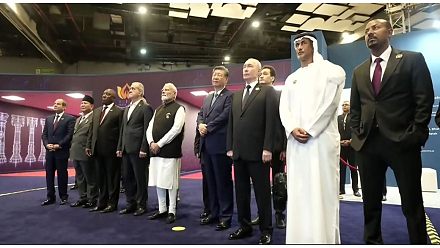
4 AM Breakthrough: How India Brought Iran, UAE, Russia, China On The Same Page For BRICS Declaration
India’s successful adoption of the New Delhi Declaration at the BRICS Summit on Saturday was the result of a diplomatic balancing act that went down to the wire, with negotiations over the most contentious portions conti
লেখক Pragati Ratti··72K বার পড়া
4 AM Breakthrough: How India Brought Iran, UAE, Russia, China On The Same Page For BRICS Declaration
India’s successful adoption of the New Delhi Declaration at the BRICS Summit on Saturday was the result of a diplomatic balancing act that went down to the wire, with negotiations over the most contentious portions continuing until around 4 am as New Delhi sought to reconcile sharply different positions on the West Asia conflict.
The challenge was bigger than simply finding consensus on a paragraph. The expanded BRICS now includes countries that are themselves on opposing sides of regional and global disputes. Iran and the UAE had competing positions on the West Asia conflict, Saudi Arabia had its own regional calculations, Russia was wary of language that could be interpreted through the lens of the Ukraine war, while China had broader ambitions for BRICS and the Global South.
Read More: New Delhi Declaration Unveiled: BRICS Unites On Pahalgam Terror Attack, UNSC Expansion & India-Led Digital Infra
Yet all members eventually signed off on the declaration. The final document does not apportion blame for the West Asia conflict. Instead, it calls for “maximum restraint”, respect for sovereignty and territorial integrity, protection of civilians and a return to “dialogue, consultation and diplomacy”. The wording was carefully negotiated over several days and, according to reports, through an overnight diplomatic push by India.
The Big Problem India Had To Solve
The most difficult negotiations centred on West Asia, particularly the competing positions of Iran and the UAE.
According to reports, Iran wanted the declaration to explicitly refer to the unilateral attack on Iranian territory and what Tehran viewed as a violation of the UN Charter. The UAE, meanwhile, wanted the document to recognise Iranian attacks on its sovereignty and territory. This created an obvious problem for India as the BRICS chair.
A formulation that directly endorsed Tehran’s position risked alienating Abu Dhabi, while language explicitly criticising Iran would have been unacceptable to Tehran.
A source familiar with the negotiations was quoted by The New Indian Express as saying that Iran did not want its position to be “subsumed into a generic formulation”. The report said that India was engaging with the issue at both official and political levels, with negotiations continuing late into the night.
India ultimately moved the conversation away from determining who should be blamed and towards principles that both sides could accept. The final declaration says, “We express deep concern over the continued escalation of tensions in Middle East/West Asia and, recalling our respective national positions, call for exercising maximum restraint, as well as avoiding actions that could further aggravate the situation.”
This phrase – “recalling our respective national positions” – was critical. It allowed countries to retain their individual positions without forcing BRICS to endorse one side’s narrative.
The Careful Wording
The eventual formulation focused on sovereignty, territorial integrity, civilian protection, de-escalation and diplomacy rather than directly naming countries involved in the conflict. The declaration calls for efforts “through dialogue and diplomacy” towards a long-term understanding that can contribute to peace and stability in West Asia. It also stresses the importance of maintaining global trade, supply chains and energy flows.
The final language reflected the need to accommodate differing national positions while urging restraint.
Former Indian ambassador to the UAE Sunjay Sudhir told Reuters that India had succeeded in keeping difficult conversations going and providing a setting where countries with sharply divergent positions could continue engaging. “What India has done is keep the difficult conversations going,” Sudhir said, underlining the role of diplomacy in creating space for countries to find common ground.
Iran And UAE Also Engaged Directly In Delhi
India’s diplomatic effort was helped by another significant development on the sidelines of the summit as Iranian President Masoud Pezeshkian met Abu Dhabi Crown Prince Sheikh Khaled bin Mohamed bin Zayed Al Nahyan. The meeting was significant given the tensions between Tehran and Abu Dhabi and offered a separate channel for the two sides to discuss regional stability and de-escalation.
reports noted that the engagement came at a time when Iran and Gulf countries were seeking ways to manage the consequences of the wider conflict, including concerns around trade and the security of vital maritime routes.
For India, such interactions mattered because consensus in a multilateral document becomes easier when the countries themselves are willing to keep diplomatic channels open. New Delhi therefore did not need to “convince” Iran and the UAE to agree with each other. It needed to find language that allowed both to sign the same document without giving up their national positions.
Russia Had Its Own Red Lines
West Asia was not India’s only negotiating headache. According to the Hindustan Times, Russia was also uncomfortable with formulations relating to conflicts that could be interpreted as referring to Ukraine. That helps explain one of the declaration’s most conspicuous features that there is no direct reference to the Russia-Ukraine war in the manner seen in some earlier BRICS declarations.
Reports also highlighted the absence of an explicit Ukraine paragraph as part of the document’s careful balancing act. For Moscow, avoiding language that could put Russia in the dock was important. For India, it also helped prevent the BRICS declaration from becoming a document dominated by the Russia-Ukraine conflict.
The solution was again to rely on broader principles – sovereignty, territorial integrity, peaceful resolution of disputes and diplomacy – without attaching them directly to a particular conflict.
China And The Larger BRICS Agenda
China did not appear to be the central obstacle in the West Asia negotiations, but Beijing had its own interests in the final document.
Chinese President Xi Jinping has repeatedly called for a greater role for multilateral institutions and the Global South in global affairs. Those priorities find considerable space in the New Delhi Declaration.
The document pushes for greater representation of developing countries in global governance, reform of multilateral institutions and stronger cooperation among Global South countries. It also raises concerns about unilateral trade restrictions, tariffs and protectionist measures.
This gave China substantial common ground with the document without forcing India to turn BRICS into an explicitly anti-US grouping.
The same balancing act is visible in the treatment of tariffs. The declaration criticises unilateral and protectionist trade measures but does not directly name US President Donald Trump.
For New Delhi, this was important. India had to accommodate the priorities of China and Russia while ensuring that the BRICS document did not unnecessarily sharpen its own relationship with Washington.
The Breakthrough Had Been Building For Months
The most important part of the story is that the final consensus was not achieved in the final hours alone. India had already faced difficulty getting the bloc to agree on West Asia earlier this year.
The Indian Express reported that a BRICS meeting in April failed to reach consensus on the conflict, forcing India to issue a Chair’s Summary instead of a joint statement. The issue remained difficult at the May foreign ministers’ meeting as well. This made the September breakthrough even more significant.
India’s negotiators had spent months working through the differences before the leaders arrived in New Delhi. By the summit, the negotiations had become a painstaking exercise in finding language that no member would consider unacceptable. The final stretch reportedly continued for several days, with the decisive negotiations running until around 4 am on Saturday.
The final declaration therefore represents less a grand compromise on the world’s conflicts and more a carefully constructed diplomatic space in which countries that disagree profoundly could still agree on a common text.
That is why the most revealing line in the document is also the least dramatic: BRICS members “reiterate our commitment to the peaceful resolution of international disputes through dialogue, consultation and diplomacy”.
For India, that principle became the bridge between positions that, only months earlier, had proved impossible to reconcile. After negotiations that stretched into the early hours, New Delhi had managed to get everyone to cross it.