0.4% UPI MDR: Traders Say They’ll Promote Cash. Will Festive Sales Take A Hit?
The government’s decision to introduce a 0.4% Merchant Discount Rate (MDR) on certain UPI merchant transactions above Rs 2,000 has triggered concern among traders, with several associations warning that the additional co
লেখক Saurabh Verma··106K বার পড়া
0.4% UPI MDR: Traders Say They’ll Promote Cash. Will Festive Sales Take A Hit?
The government’s decision to introduce a 0.4% Merchant Discount Rate (MDR) on certain UPI merchant transactions above Rs 2,000 has triggered concern among traders, with several associations warning that the additional cost could push businesses to encourage cash payments ahead of the festive season.
The new framework, which ends the zero-MDR regime for specified high-value merchant transactions, has come into effect as retailers and traders prepare for one of the busiest shopping periods of the year. The MDR will be capped at Rs 300 for transactions of Rs 75,000 and above.
While the government has maintained that consumers will not bear the charge, traders argue that the additional cost will ultimately put pressure on businesses already operating on thin margins.
Also Read | UPI Charges From October 15: Who Pays, How Much And What Stays Free?
‘We Will Promote Cash’: Traders
Kamla Nagar Market Association president Nitin Gupta said traders had supported the government’s push towards digital payments but could now reconsider their approach if they have to pay MDR.
“We were already paying transaction charges and 18 per cent GST. Now if the government charges us on UPI MDR, then we will promote cash,” Gupta said.
“When the government came with the UPI payment method, we supported it. Now if we are charged for UPI transactions also, then we will not support it and start promoting cash payments. Why should we pay transaction charges?” he added.
Gupta, however, acknowledged that consumers and traders have become heavily dependent on digital payments. “We have got used to digital payments. Even when we go to the market, sometimes we don’t even carry cash. It will be tough for us to go back to cash payments,” he said.
New Delhi Traders Association general secretary Amit Gupta said the additional charge could make UPI payments less attractive for businesses operating on tight margins.
“UPI was introduced to make digital payments easier for both traders and customers. If traders are now asked to bear an additional charge on transactions above Rs 2,000, many of them will prefer cash payments,” he said.
“We have no issue with digital payments, but the additional cost should not be imposed on traders,” he added.
Sanjiv Mehra, president of the Khan Market Association, said traders were already opposing MDR on credit card transactions and would now have to deal with charges on UPI payments.
“We were already fighting against MDR on credit cards and now we will be charged on UPI also. If we are charged on UPI transactions, then we will promote cash payments,” Mehra said.
He added that traders could also consider cheques and other banking channels for larger payments to wholesalers and other businesses.
Why Small Retailers Are Worried
For smaller retailers, traders say the concern is not necessarily the size of the charge on an individual transaction, but its cumulative impact.
Rajat Jain, a retail shopkeeper in Kamla Nagar, said the new charge could be particularly difficult for businesses operating near Delhi University colleges, where customers frequently make small purchases.
“A lot of students come here, and some of them buy products worth Rs 10 or Rs 20 also. Now we can’t ask them to pay even one penny extra, but we are paying GST and other charges, and now we are expected to pay on UPI also,” Jain said.
“Even if we ask customers to pay in cash, they say they use UPI. So like this, all the burden is on us,” he added.
Sadar Bazar Bari Market Traders Association president Paramjit Singh Pamma said the move could increase costs for small, medium and wholesale traders handling a large number of UPI transactions above Rs 2,000.
He said even a small charge on individual transactions could become a significant expense over a month or a year and urged the government to keep digital payments low-cost for traders.
Festive Season Concern
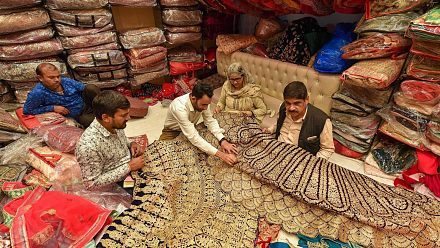
The timing of the new MDR has become another major concern for the retail industry, with traders preparing for the festive shopping season when transaction volumes typically rise.
Santosh Katariya, president of the Clothing Manufacturers Association of India (CMAI), said the introduction of MDR at the start of the festive season could put additional pressure on retailers.
“Introducing MDR on UPI at the start of festive season could not have come at a more challenging time for the industry,” Katariya said.
He said merchants, retailers and consumer-facing businesses were already working to revive demand and improve margins.
“Adding another cost to digital transactions at this juncture risks putting further pressure on an ecosystem that is still finding its footing,” he said.
Katariya added that UPI has played an important role in driving consumption and formalisation and that any increase in the cost of accepting digital payments should be carefully calibrated.
Retailers Association Flags Cash Shift
The Retailers Association of India (RAI) has also raised concerns over the new MDR, warning that the charge could encourage smaller retailers to steer customers towards cash.
“Small merchants will now think twice about whether to accept cash or UPI,” RAI CEO Kumar Rajagopalan said.
“During the festive season, a large share of transactions crosses the Rs 2,000 mark, and the moment a fee attaches itself to digital payment, cash becomes the path of least resistance,” he added.
RAI has also argued that a shift from UPI to cash could work against the government’s broader formalisation push.
“This cuts against the government’s own formalisation agenda,” Rajagopalan said. “UPI acceptance should be incentivised, not taxed.”
The association has called for a distinction between debit-linked and credit-linked UPI transactions, arguing that regular bank-to-bank UPI payments do not carry the same cost structure as credit transactions.
“We don’t see the case for charging a bank-to-bank UPI payment the way you’d charge for credit,” Rajagopalan said.
Also Read | The 2026 Payment Playbook: How UPI, Credit Cards, Netbanking & Cash Compare Across Spend Categories
What The Government Says
Under the new framework, the MDR will apply only to specified person-to-merchant (P2M) transactions. Person-to-person (P2P) UPI transfers will remain outside the charge.
The government has also said that the MDR cannot be passed on to consumers. Small merchants earning up to Rs 1 lakh a month through UPI QR codes will remain exempt, with the government estimating that around 96% of merchant transactions will continue to attract zero MDR.
The framework also provides sector-specific caps for areas such as fuel, insurance and agriculture, while capital market transactions will attract a lower MDR.
For traders, however, the central question remains whether even a limited charge on larger UPI payments will change payment behaviour during the festive season.
If businesses begin encouraging cash to avoid MDR, the impact could extend beyond merchant costs — potentially affecting how consumers pay at a time when retail activity is expected to pick up.