Who Was Mahishasura? The Story Of The Demon Slain By Goddess Durga
There are some battles that are fought for kingdoms, some for power, and others for the very balance of the universe. In Hindu mythology, the battle between Goddess Durga and Mahishasura belongs to the last kind, a celes
লেখক Lifestyle Desk··12K বার পড়া
Who Was Mahishasura? The Story Of The Demon Slain By Goddess Durga
There are some battles that are fought for kingdoms, some for power, and others for the very balance of the universe. In Hindu mythology, the battle between Goddess Durga and Mahishasura belongs to the last kind, a celestial confrontation in which the fate of the gods, and the order they were meant to uphold, hung in the balance.
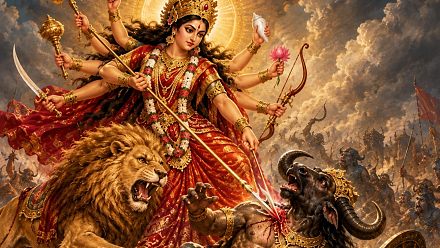
Every year, as Navratri fills the air with devotion and Durga Puja brings the image of the goddess slaying the buffalo demon into public view, the story returns with renewed force. Durga stands radiant and composed, her many arms bearing divine weapons, her lion poised beneath her, and her trident directed at the demon who dared to challenge the heavens.
But who was Mahishasura? How did he acquire such formidable power, and why did the gods need the intervention of a goddess to defeat him?
His story, narrated in the Devi Mahatmya, a sacred text forming part of the Markandeya Purana, is more than a tale of a demon’s downfall. It is also a meditation on the dangers of unchecked power, the limits of arrogance and the extraordinary force of the divine feminine.
Who Was Mahishasura?
Mahishasura’s name offers the first clue to his identity. Derived from mahisha, meaning buffalo, and asura, referring to a class of powerful beings often portrayed as antagonists of the devas, his name is commonly understood as “buffalo demon”.
In Hindu mythology, Mahishasura is known for his formidable strength and his ability to change forms. His buffalo form became the defining image associated with him, symbolising the immense force he brought to his battles.
Yet Mahishasura’s story is not simply about physical might. His rise represents a power that grows beyond restraint, one that begins to mistake its own strength for the right to rule. In the traditional account, he wages war against the devas, defeats them and seizes control of heaven, displacing Indra, their king.
The gods, who are entrusted with maintaining cosmic order, find themselves powerless before the very force they are supposed to contain. Their defeat sets the stage for one of the most celebrated appearances of the Goddess in Hindu sacred literature.
The Boon That Made Mahishasura Fearless
The legend of Mahishasura is often associated with a boon that leaves him convinced he cannot be defeated by any man or god. In popular retellings, he asks that no male being be capable of killing him, underestimating the possibility that a woman could become his downfall.
This detail is central to the story’s spiritual significance. Mahishasura’s confidence rests not only on the protection he believes he has secured but also on his assumption that feminine power poses no serious threat to him.
There is a striking irony here. The very possibility he dismisses becomes the means of his defeat.
The precise details of Mahishasura’s origins and boon vary across later retellings of the myth. However, in the widely known account, his growing power leads him to wage war against the devas and claim dominion over their celestial realm. With the gods driven from heaven, the cosmic order is thrown into disarray.
The lesson is not that power itself is evil, but that power without humility or responsibility can become destructive. Mahishasura’s downfall begins long before the final blow: it begins when he mistakes a boon for absolute invincibility.
How Goddess Durga Came Into Being
Unable to defeat Mahishasura, the gods approach Brahma, Vishnu and Shiva for help. Their collective anguish and divine energy give rise to a radiant feminine form, the Goddess, who emerges as a force capable of confronting the demon.
This is no ordinary warrior entering the battlefield. She embodies the combined energies of the gods, yet her presence carries an authority of its own. The devas offer her their weapons: Shiva’s trident, Vishnu’s discus and Indra’s thunderbolt, among others. She is mounted on a lion, an image of courage, sovereignty and untamed strength.
The Goddess is known by several names in this tradition, including Chandika and Durga. Her appearance is both beautiful and formidable, challenging the assumption that gentleness and strength must exist at opposite ends of the same spectrum.
In the story, the gods do not simply send a champion to fight on their behalf. Their energies converge to bring forth a power that none of them, acting alone, could manifest in the same way.
This is one of the most enduring ideas in the legend: when the established order falters, a force beyond its familiar boundaries may emerge to restore balance.
The Epic Battle Between Durga And Mahishasura
When Mahishasura learns of the Goddess, he sends his forces against her. What follows is a fierce battle between Durga and the armies of the asuras. One after another, his commanders fall, but Mahishasura continues to resist.
The demon uses his ability to change forms to evade and confront the Goddess. He appears as a buffalo, a lion, an elephant and other forms in the course of the battle, attempting to overpower her through sheer force and transformation.
Yet Durga remains undeterred. She meets each manifestation with unwavering resolve, refusing to be overwhelmed by the demon’s changing appearance or his immense strength.
The final confrontation is the moment immortalised in temple sculptures, paintings, devotional hymns and Durga Puja pandals across India. Mahishasura appears in his buffalo form as the Goddess attacks, pinning him down and striking him with her trident. As he emerges from the buffalo form, she delivers the decisive blow.
The demon is slain. The devas regain their celestial realm, and cosmic order is restored.
It is this victory that gives Durga one of her most revered titles: Mahishasura Mardini, or the slayer of Mahishasura.
The story is preserved in the Devi Mahatmya, whose account of the Goddess’s triumph has inspired generations of worshippers and artists. Its influence can be seen in the celebrated Mahishasuramardini sculptures at Mamallapuram, Tamil Nadu, where the battle is rendered in stone with remarkable movement and intensity.
What Does Mahishasura’s Defeat Symbolise?
The story of Mahishasura has endured for centuries because its meaning reaches beyond the battlefield. At its heart lies the struggle between dharma, or righteous order, and the forces that threaten to disrupt it.
Mahishasura’s strength is undeniable, but it is accompanied by arrogance and the desire to dominate. His defeat suggests that power, however overwhelming it may appear, cannot guarantee lasting victory when it is divorced from responsibility.
For devotees, the Goddess’s victory offers reassurance that darkness does not have the final word. For others, the story remains a powerful cultural and philosophical narrative, one that has shaped Indian art, ritual and collective memory for centuries.
Mahishasura’s name survives not because he conquered heaven, but because his defeat became one of Hindu mythology’s defining images. The demon beneath Durga’s foot serves as a reminder that no force is beyond challenge, and no display of power is a substitute for wisdom.