Before The Mosques And Madrasas: Fayaz Tepa And Kara Tepa Reveal Uzbekistan’s Buddhist Connection To India
When Prime Minister Narendra Modi announced India’s cooperation with Uzbekistan to restore and conserve the ancient Buddhist sites of Fayaz Tepa and Kara Tepa, the news drew attention to a remarkable and often overlooked
লেখক Swati Chaturvedi··18K বার পড়া
Before The Mosques And Madrasas: Fayaz Tepa And Kara Tepa Reveal Uzbekistan’s Buddhist Connection To India
When Prime Minister Narendra Modi announced India’s cooperation with Uzbekistan to restore and conserve the ancient Buddhist sites of Fayaz Tepa and Kara Tepa, the news drew attention to a remarkable and often overlooked chapter of Buddhist history.
Before Uzbekistan became globally associated with the turquoise domes, madrasas and Islamic architecture of cities such as Samarkand and Bukhara, its southern region was home to thriving Buddhist communities. Near present-day Termez, close to the Amu Darya, Buddhist monks once lived, worshipped and studied in monasteries that formed part of the wider cultural networks linking India, Central Asia and the ancient Silk Road.
During Modi’s August 2026 state visit to Tashkent, India and Uzbekistan agreed on a Letter of Intent for the restoration and conservation of Fayaz Tepa and Kara Tepa, bringing renewed attention to these extraordinary archaeological sites.
Fayaz Tepa: A Buddhist Monastery in Ancient Bactria
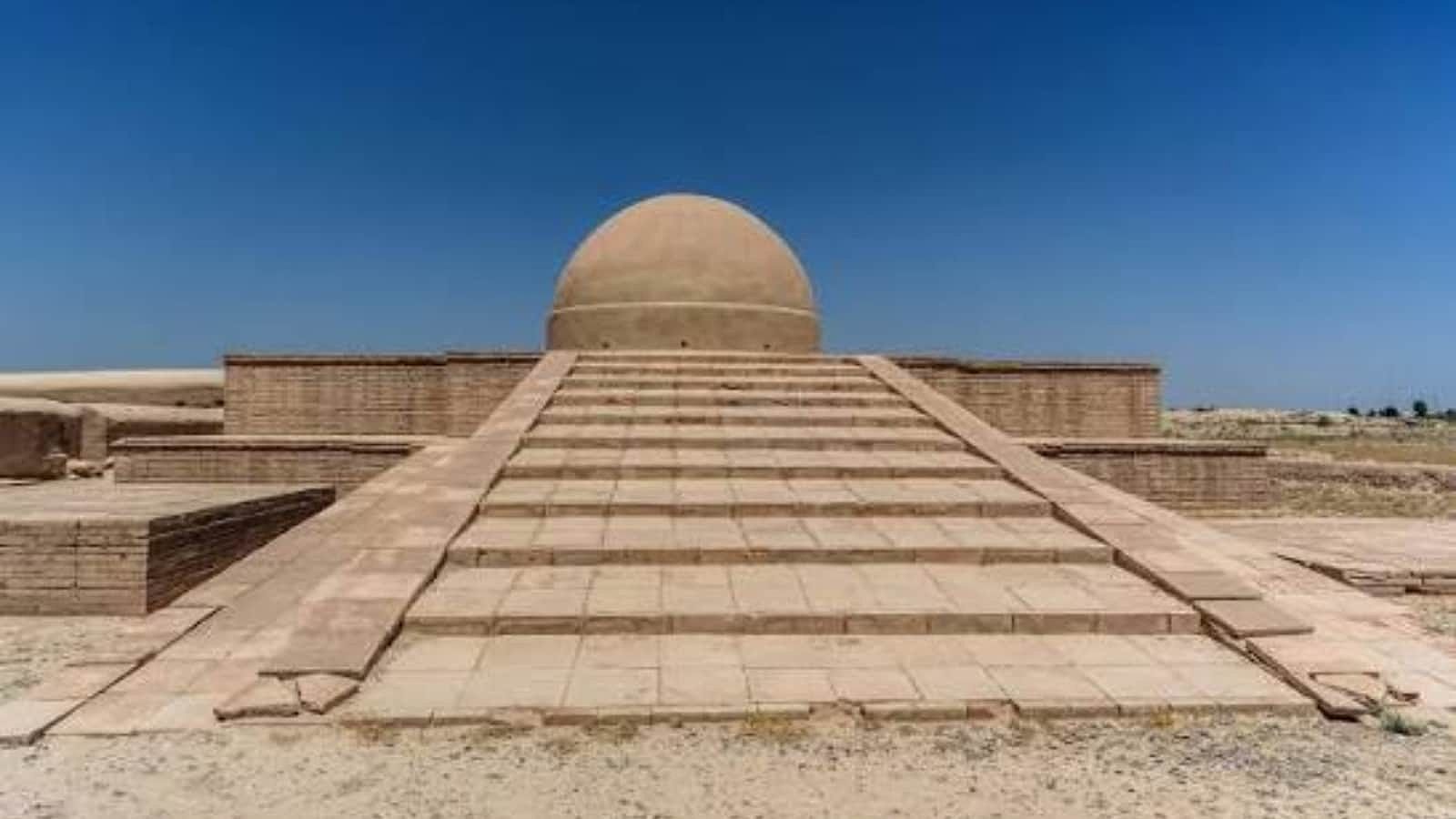
Located near Termez, Fayaz Tepa was a Buddhist monastic complex dating back to the early centuries CE. Archaeological evidence shows that the complex consisted of three connected sections, with courtyards and rooms, including a central chamber decorated with colourful paintings of Buddhist figures. Clay and stucco sculptures, as well as Buddhist stone reliefs, were also discovered at the site. A stupa stood outside the main chamber.
The discoveries at Fayaz Tepa reveal that Buddhism was not simply passing through Central Asia. It had developed established religious communities and artistic traditions in the region.
Perhaps even more fascinating for Indian readers is the discovery of Indian inscriptions at the site. Archaeological research recorded around 35 inscriptions in Indian scripts, demonstrating the deep cultural and religious connections between ancient South Asia and this part of Central Asia.
Kara Tepa: The Extraordinary Buddhist Cave Monastery
Just about a kilometre away from Fayaz Tepa lies Kara Tepa, one of the most important Buddhist archaeological complexes in Central Asia.
Unlike Fayaz Tepa, Kara Tepa included a remarkable combination of above-ground structures and underground cave monasteries. The complex covered approximately seven hectares and contained interconnected spaces built and expanded over different periods. Archaeologists found courtyards, stupas, water tanks, sculpture niches and underground chambers.
Construction at Kara Tepa began around the first and second centuries CE, while the complex reached its peak during the third and fourth centuries before declining in later centuries.
The site has produced an extraordinary collection of Buddhist art, including stone and stucco sculptures, paintings and architectural remains.
The Indian Connection Hidden in the Ruins
Perhaps the strongest reason these sites matter to Indian readers is what archaeologists found written on pottery and other objects.
More than 150 inscriptions in Indian scripts, including Kharosthi and Brahmi, have been discovered at Kara Tepa. Fayaz Tepa has also yielded dozens of Indian-script inscriptions. UNESCO’s Silk Roads research notes that Termez, particularly the monasteries of Kara Tepa and Fayaz Tepa, produced a significant number of inscriptions from the Kushan period.
These inscriptions offer powerful evidence of how closely connected ancient India and Central Asia once were.
Monks, merchants and travellers moved across vast distances, carrying not only goods but also languages, religious ideas, artistic styles and cultural traditions.
A Story of Buddhism and the Silk Road
The sites flourished during the broader Kushan period, when territories across parts of South Asia, Afghanistan and Central Asia were linked through trade and political networks.
Buddhism travelled along these routes, reaching communities far beyond the Indian subcontinent. Termez became one of the important centres of Buddhism in the region, with monasteries that reflected interactions between Indian and Central Asian traditions.
For many Indians, this history can be surprising. We often think of Buddhism’s journey as moving from India towards Sri Lanka, Southeast Asia, China and Japan. But Central Asia was also a crucial part of that story.
The ruins of Kara Tepa and Fayaz Tepa are physical reminders of a time when Buddhist monks and communities flourished in what is now Uzbekistan.
Why the India-Uzbekistan Restoration Agreement Matters
The new cooperation is not simply about preserving ancient ruins. For Uzbekistan, restoring Fayaz Tepa and Kara Tepa can help preserve an important part of its multicultural history. For India, the sites represent a tangible connection to the journey of Buddhism beyond its birthplace and to centuries-old cultural links across Central Asia.
The agreement also comes at a time when interest in India’s ancient cultural connections with the wider world is growing.
Fayaz Tepa and Kara Tepa tell a story that deserves greater attention: long before modern borders divided the region, ideas travelled freely across mountains, deserts and trade routes and Buddhism was one of the most powerful forces connecting India with Central Asia.
The next time we think of Uzbekistan, it may be worth remembering that alongside its famous Islamic monuments lies another extraordinary heritage.
Near Termez, the remains of Buddhist temples, monasteries, sculptures and inscriptions in Indian scripts still tell the story of an ancient world connected by the Silk Road.
And with India and Uzbekistan now working together to conserve Fayaz Tepa and Kara Tepa, two forgotten Buddhist centres may finally receive the global attention they deserve.