Rift Between Harmanpreet Kaur And Smriti Mandhana: Captaincy Became Flashpoint
Smriti Mandhana is expected to take over as captain of the Indian women’s cricket team after Harmanpreet Kaur stepped down across formats on Tuesday. While from outside the change in guard appears a smooth affair, it was
بقلم Feroz Khan··91K قراءة
Rift Between Harmanpreet Kaur And Smriti Mandhana: Captaincy Became Flashpoint
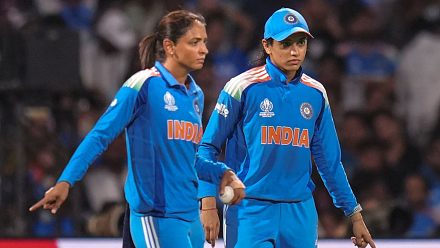
Smriti Mandhana is expected to take over as captain of the Indian women’s cricket team after Harmanpreet Kaur stepped down across formats on Tuesday. While from outside the change in guard appears a smooth affair, it was anything but.
According to a report, the transition comes after a period of alleged friction between the two senior players, with differences over captaincy adding to an unease within the dressing room too.
“They were not seeing eye to eye for a while now and that led to an obvious unease in the dressing room,” a team source told news agency PTI.
Harmanpreet’s decision to relinquish the captaincy followed a review meeting with the BCCI. The 37-year-old from Moga, who first took charge of India in 2016, ended a path-breaking leadership tenure on a high after guiding the team to a second consecutive Asian Games gold in Japan.
There has been no official announcement from the BCCI yet, but Mandhana is the obvious candidate to succeed Harmanpreet.
The 30-year-old left-hander has long established herself as India’s premier batter, with more than 10,000 international runs since making her debut in 2013. Her batting, already built on timing and elegance, has evolved further in recent years, with greater power adding another dimension to her game.
Yet the captaincy transition has been a long time coming.
Mandhana had made no secret of her frustration with the selectors’ decision to retain the status quo even after India ended their long wait for an ICC trophy by winning the ODI World Cup at home last year.
In a recent interview, she indicated her readiness to lead India, while following the Asian Games triumph she spoke of the need for the team to set its sights on bigger tournaments.
The debate over leadership had intensified amid India’s struggles in T20 cricket. The team suffered premature exits from successive T20 World Cups, bringing greater scrutiny on the captaincy, particularly in the shortest format.
The selectors, however, chose not to make an immediate change.
That changed at the review meeting in Guwahati, chaired by BCCI Secretary Devajit Saikia, where Harmanpreet was made aware that a change of guard was inevitable. She eventually chose to step down herself.
The captaincy issue had also become a source of tension between Harmanpreet and Mandhana, despite the two having shared a good relationship in the past.
The friction adds another layer to what is already a significant leadership transition for Indian women’s cricket.
After India’s T20 World Cup exit in the UK earlier this year, former captain Mithali Raj had said the selectors should have handed the ODI captaincy to Mandhana two or three years earlier, while suggesting that the T20 role could have gone to a younger player such as Shafali Verma.
“I thought she would be given the captaincy of the ODI format two-three years back. She can still be the ODI and Test captain and the T20 captaincy could be given to someone younger like Shafali (Verma),” Mithali had told PTI.
The latest transition is not without precedent. When Harmanpreet succeeded Mithali as ODI captain following the 2022 World Cup, relations between the two veterans had deteriorated, contributing to factionalism within the team.
Harmanpreet, however, is expected to continue as a player for the next two or three years. That makes her relationship with the new captain particularly important as India enter another phase of transition.
While India dominated the recent Asia Cup and Asian Games, Harmanpreet’s contributions with the bat were limited. With the captaincy burden now lifted, the expectations on her as a specialist batter will only increase.
For Mandhana, meanwhile, the challenge is not merely to inherit the captaincy but to establish her authority over a team that has already experienced the complications of a difficult leadership transition.
Whether the two can put their differences aside and work together for the team’s cause will be one of the more closely watched subplots of India’s next chapter.