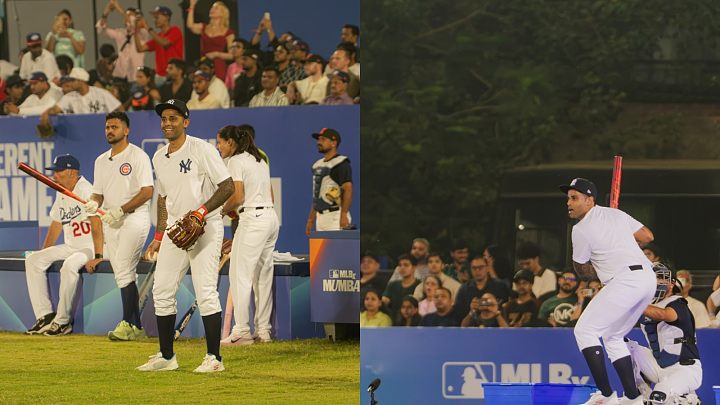
Cricket Vs Baseball: How MLBx Mumbai Reignited Age-Old Sporting Debate
The debate over whether cricket or baseball demands greater skill has resurfaced on social media after MLBx Mumbai brought Indian cricket stars and Major League Baseball players together for a sporting crossover.
بقلم Kasiviswanathan V··138K قراءة
Cricket Vs Baseball: How MLBx Mumbai Reignited Age-Old Sporting Debate
The debate over whether cricket or baseball demands greater skill has resurfaced on social media after MLBx Mumbai brought Indian cricket stars and Major League Baseball players together for a sporting crossover.
Held at Mumbai Football Arena on October 24, the event featured India’s T20 World Cup-winning captain Suryakumar Yadav, Shardul Thakur and other Indian cricketers alongside former MLB stars, including Nick Swisher and Adrián González. The modified three-on-three contest featured home runs and defensive catches, with the New York Yankees emerging as champions.
But the event also revived a familiar question: Which sport is harder to play?
Social media turns it into a contest
Clips from the event sparked comparisons between the two sports on X. Some cricket fans highlighted the difficulty of catching a hard cricket ball without gloves, while baseball supporters pointed to spectacular catches made by players wearing gloves. Videos showcasing athletic fielding from both sports soon became part of the debate.
Lemme know if a cricket player could ever do this https://t.co/7pa1xd7KkA
— Crobin Carol Enthusiast (@CorbrielCarreno) October 26, 2026
The discussion soon shifted to the speed of the ball. Baseball supporters argued that facing pitches regularly delivered at more than 95 mph (153 km/h) is a challenge in itself, questioning whether cricket batters could cope with such pace.
Glenn Phillips is just unreal. Look at him, he is literally flying here.
How the hell, baseball fans compare fielding of baseball players with cricketers???? https://t.co/FGICLv3cvh
— Rajiv (@Rajiv1841) October 27, 2026
Cricket fans hit back, pointing out that speed alone does not determine how difficult a delivery is to face. A full toss may appear easier to hit, they argued, but cricket batters must also contend with swing, seam movement, spin and unpredictable bounce.
The exchange highlighted the fundamental difference between the two sports: while baseball tests a batter’s ability to react to pace and movement through the air, cricket demands adjustments to both the ball’s flight and its behaviour after pitching.
This single catch mogs entire 🧤🧤 Baseball catches
And a leather rock-hard rigid Cricket ball is much harder & denser than a Baseball ball
https://t.co/UCJOsaddyI
— The King In The North (@KingInThe3North) October 26, 2026
Batting also became a talking point, with fans questioning whether hitting a baseball is easier than facing a cricket delivery. Suryakumar’s involvement added to the interest, given his reputation for inventive strokeplay and his ability to hit sixes from unusual positions.
However, the argument is more complicated than a few viral clips might suggest. Although cricket and baseball share a basic premise, their rules, equipment and required skills are quite different.
I am begging the best of the best cricket players on the planet to come face this lol. Please it would be the funniest thing ever
— JL (@JLas43_) October 26, 2026
Cricket Vs Baseball: A Look At Basic Differences
Feature
Cricket
Baseball (MLB)
Pitch length
22 yards (20.12 m)
60 ft 6 in (18.44 m) from pitching plate to home plate
Playing area
Oval or irregular; boundary varies
Diamond-shaped infield; outfield dimensions vary by stadium
Formats
Tests, ODIs and T20s
Nine-inning games, with extra innings if required
Bat
Flat-faced; maximum length 38 inches
Rounded barrel; maximum length 42 inches
Ball weight
About 156-163 g
About 142-149 g
Fastest widely cited delivery
161.3 km/h, Shoaib Akhtar
170.3 km/h, Aroldis Chapman
Delivery variations
Swing, seam, spin, pace and bounce
Fastballs, sliders, curveballs, changeups and other pitches
Boundary scoring
Six runs when hit over the boundary without bouncing
A home run allows the batter and any runners on base to score
A key distinction is that a cricket ball generally bounces before reaching the batter, whereas a baseball pitch normally travels through the air. Cricket grounds also vary in size, and there is no single distance that defines a six. Similarly, the distance required for a home run in baseball depends on the stadium and the part of the outfield being targeted.
Why cricket is difficult
A cricket batter must judge not only the speed of a delivery but also its line, length and movement. The ball can swing through the air, deviate off the pitch or turn sharply after pitching. A full toss, which reaches the batter without bouncing, can be easier to attack in certain circumstances. However, it can still be difficult to hit when delivered at high speed or directed towards the body or toes.
Playing conditions add another layer of difficulty. Overcast weather in England can favour swing bowling, while Australian pitches, particularly in Perth, are known for their pace and bounce. In the subcontinent, some surfaces offer increasing assistance to spinners as matches progress.
The format matters, too. A batter in a Test match may need to concentrate for hours, while a T20 player has to make quick decisions under pressure. Fielders, apart from the wicketkeeper in the usual circumstances, also catch the hard ball without protective gloves. Bowling long spells and maintaining accuracy demand considerable physical and mental endurance.
The format matters, too. A batter in a Test match may need to concentrate for hours, while a T20 player must make quick decisions under pressure. Fielders, apart from the wicketkeeper in normal circumstances, also have to catch the hard ball without protective gloves. Bowling long spells while maintaining accuracy demands considerable physical and mental endurance.
Why baseball is difficult
Baseball presents a different kind of challenge. During the 2026 MLB season, four-seam fastballs averaged 94.8 mph (about 153 km/h), according to Statcast data. Batters must identify the type of pitch and decide whether to swing within a fraction of a second.
A fastball is only one part of the challenge. Breaking pitches can move sideways or drop sharply, while changeups disrupt a batter’s timing. The rounded bat also offers a narrower effective contact area than cricket’s flat blade, making precise contact essential.
Success is measured differently, too. A baseball batter can make good contact and still be caught or fail to reach base. Even an excellent MLB batting average of .300 means getting a hit in roughly three out of every ten official at-bats. Pitchers, meanwhile, must repeatedly deliver at high speeds while maintaining control, making the physical demands of pitching considerable.
Can cricket and baseball skills be compared?
Crossover experiences offer an interesting perspective. England batter Harry Brook visited the St. Louis Cardinals’ training camp in 2023 to learn about baseball, while Jos Buttler has also tried his hand at baseball batting. Both sports reward hand-eye coordination, timing and power, but their techniques are not interchangeable.
The same applies to fielding. Cricket’s unprotected catches demand soft hands and the ability to absorb the impact of the ball. Baseball gloves provide protection, but fielders must still judge the ball’s flight, position themselves correctly and make difficult catches at speed.
Neither skill should be dismissed simply because it looks easier on a screen.
Two sports, different challenges
The cricket-versus-baseball debate is unlikely to disappear. Fans will continue to compare sixes with home runs, fast bowlers with pitchers, and spectacular catches with equally impressive defensive plays.
However, a viral clip cannot capture the full demands of either sport. Cricket tests a batter’s ability to handle bounce, movement and changing playing conditions. Baseball demands precise timing against high-speed pitches and a variety of ball movements.
Both sports reward years of practice, athletic ability and decision-making under pressure. Perhaps the more interesting takeaway from MLBx Mumbai is not which sport is harder, but how much each can learn from the other.