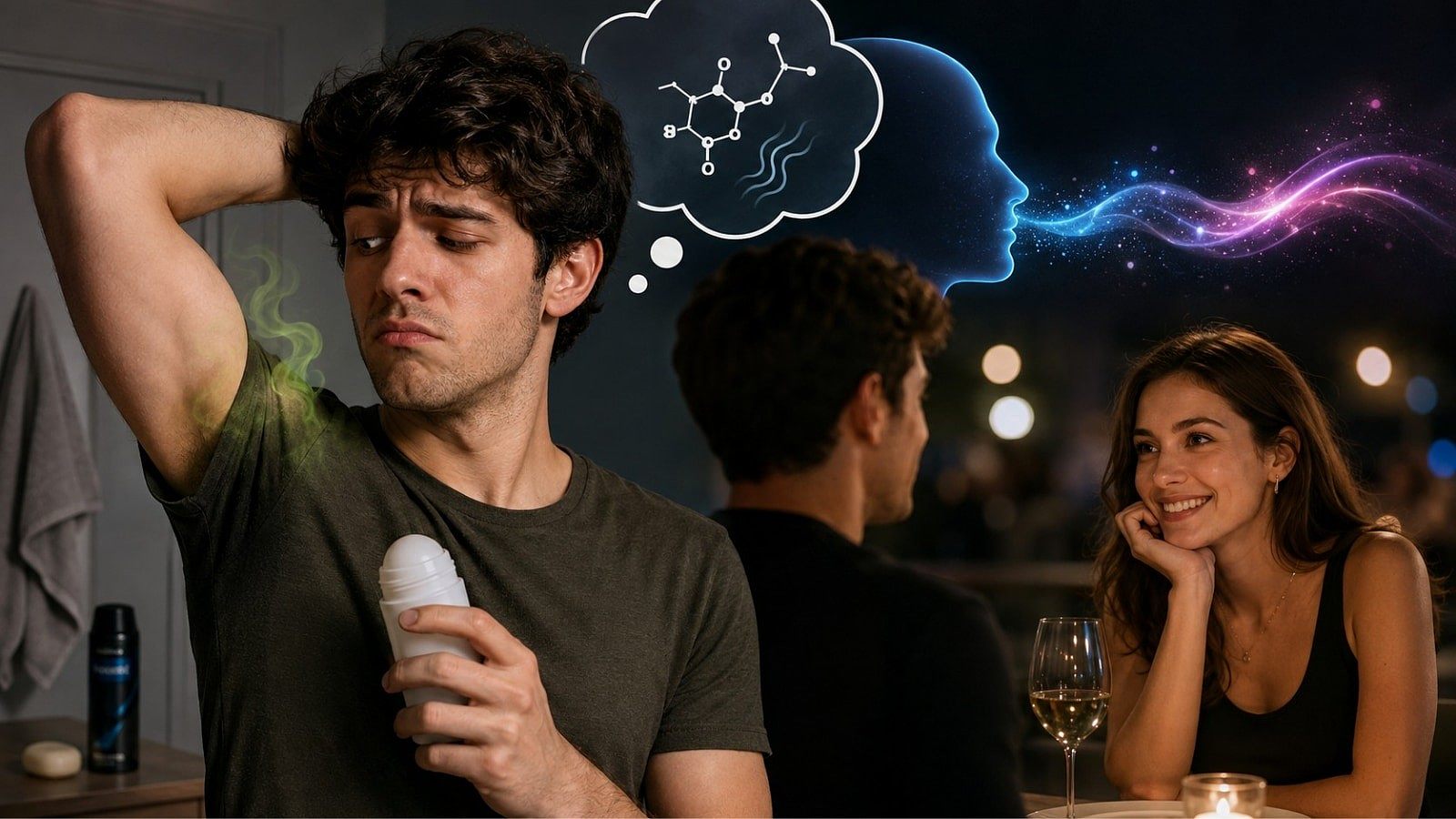
Gen Z Men Are Skipping Showers Before Dates In Viral ‘Pheromone-Maxxing’ Trend: But Does It Work?
A bizarre dating trend dubbed “pheromone-maxxing” is taking social media by storm, with young men and teens deliberately skipping showers and deodorant before dates. The unusual practice is based on the belief that their
بقلم Sakshi Arora··30K قراءة
Gen Z Men Are Skipping Showers Before Dates In Viral ‘Pheromone-Maxxing’ Trend: But Does It Work?
A bizarre dating trend dubbed “pheromone-maxxing” is taking social media by storm, with young men and teens deliberately skipping showers and deodorant before dates. The unusual practice is based on the belief that their natural body odour could make them more attractive to potential partners.
The trend, which has been circulating on TikTok and is now being discussed widely on X, is linked to the broader “looksmaxxing” movement. The online phenomenon encourages people, particularly young men, to adopt different strategies to improve their physical appearance and perceived attractiveness.
In the case of pheromone-maxxing, however, the focus is less on appearance and more on body odour. Followers of the trend reportedly believe that allowing their natural “musk” to develop can help them attract romantic or sexual partners.
According to Fox News, the trend primarily involves teen boys and young men skipping their usual shower and deodorant routines before meeting a prospective partner. Some proponents have reportedly taken the idea even further by wearing unwashed shirts or adopting extreme practices such as drinking their own urine in an attempt to “sweat out toxins,” Vice reported.
The theory behind the trend is based on the idea that humans may produce pheromones, chemical compounds that can transmit signals between members of the same species. Pheromones are well documented in insects and other animals, and some do not have an obvious smell, according to Scientific American.
However, whether humans have pheromones that directly influence attraction remains scientifically unresolved. Researchers have found that human body odours and secretions can affect physiological or psychological responses in other people.
One of the most frequently cited studies in discussions about smell and attraction is the 1995 “sweaty T-shirt study.” In the experiment, male participants wore the same T-shirt for two consecutive nights. Female participants were subsequently asked to rate the smell of several shirts.
The researchers found that women generally rated the body odour of men whose MHC, or major histocompatibility complex, genes were different from their own as more pleasant. MHC genes play an important role in the immune system and may also contribute to differences in individual body odour.
However, subsequent research has not produced a clear consensus. A 2019 study involving 883 couples found that participants from the Netherlands and Northern Europe were more likely to have partners with different MHC genes. The same pattern was not observed among Israeli couples, with researchers suggesting that factors such as a history of arranged marriages could potentially play a role.
A 2020 analysis of earlier research, meanwhile, found no strong evidence that people consistently prefer partners with different MHC genes or consider their body odour more attractive.
Despite the lack of conclusive scientific evidence, pheromone-maxxing has continued to attract attention online. The concept has reportedly been circulating on social media since at least 2024, when a discussion on the r/TikTokCringe subreddit received largely negative reactions.
The latest wave of interest has now spilt onto X, where users have been debating the idea of abandoning basic hygiene to enhance one’s “natural scent.”
Some social media personalities and commentators have mocked the trend, while others have questioned whether influencers are encouraging young men to follow potentially counterproductive dating advice.
The Fox News post discussing the trend prompted a wave of reactions, with many users appearing far from convinced that skipping a shower is the secret to romantic success.
“Take a shower. Put on deoderant. Brush your teeth. Maybe a light touch of cologne or after shave. Go have a date. This is not hard people,” said one user.
“It takes academics to doubt the reality that if you don’t like the way somebody smells, you may not find them attractive long term. I propose another study! Also, watch how you stank,” said another.
“This is why majority of dudes my age can hold or even come close to getting a gf. They think this is the answer🤣” said a third user.
Some men are skipping showers before dates to embrace a new trend called “pheromone-maxxing,” hoping their natural scent will make them more attractive.
But experts say the science behind the dating strategy is far from settled:
“There is no evidence of a consistent and strong… pic.twitter.com/uX3ExKIOOK
— Fox News (@FoxNews) August 29, 2026
“Stupid plan. That’s what good cologne is for,” said a fourth.
One user took the trend to an extreme while describing what “pheromone-maxxing” supposedly entails: “You need to be stinking. You need to have odor. You need to sweat and let the sweat dry and then sweat again. You need to be wearing the same clothing. You need to make people around you recoil in disgust. You need to smell like hot curry. You need to be pheromonemaxxing,” one user wrote.
Others were equally dismissive. “Stink don’t make you more attractive and neither does dosing cologne instead of showering!” said one user.
“Do NOT do this men!!! Pheromone-maxxing is no bueno,” said another.
“We’re becoming a more retarded species by the minute, honestly,” said one more user.
While the viral trend may be generating plenty of discussion and memes online, current scientific research does not establish that deliberately avoiding personal hygiene can reliably increase human attraction. For now, the idea appears to be driven more by social media trends than by established scientific evidence.