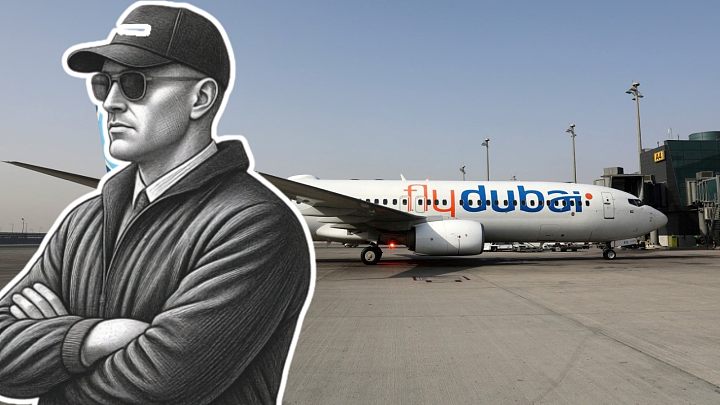
Flydubai Flight Incident Raises Questions Putting A Spotlight On Air Marshals: Does India Deploy Them On Flights?
A mid-air emergency on a flydubai flight from Dubai to Tel Aviv on 30 September 2026 has once again put the spotlight on in-flight security and the role of air marshals. Flight FZ1073 transmitted emergency signals, inclu
بقلم Tanya Dutt··46K قراءة
Flydubai Flight Incident Raises Questions Putting A Spotlight On Air Marshals: Does India Deploy Them On Flights?
A mid-air emergency on a flydubai flight from Dubai to Tel Aviv on 30 September 2026 has once again put the spotlight on in-flight security and the role of air marshals. Flight FZ1073 transmitted emergency signals, including the international code associated with unlawful interference, and made a sharp descent before diverting safely to Tabuk in Saudi Arabia.
The airline confirmed an altercation in the flight deck; the aircraft was secured by crew members on board and all passengers were accounted for. Israeli officials described the episode as a highly serious security incident, with investigations continuing into the circumstances.
The incidents has travellers asking a practical question: what kind of protection exists on commercial flights, and do Indian carriers deploy air marshals?
Image: AFP
Who Are Air Marshals?
India’s sky marshals are NSG commandos, rather than airline employees.
They travel in plain clothes and are trained for situations involving hijacking and other serious security threats on board an aircraft. Their role is to provide an additional line of defence inside the cabin if an incident escalates beyond what normal crew procedures can handle.
Their presence is intentionally discreet. According to Moneycontrol, the identity of the sky marshal is kept secret and the pilot-in-command is informed of the marshal’s presence, while other passengers are not.
Do Indian Carriers Deploy Air Marshals?
India does have a Sky Marshal programme, with specially trained National Security Guard (NSG) commandos deployed on selected domestic and international flights.
The Ministry of Home Affairs has previously documented the deployment of NSG commandos as sky marshals on designated domestic routes and international flights. A current Moneycontrol report, citing security arrangements, says the commandos travel on Indian airline aircraft as ordinary passengers, with their identities kept confidential.
Passengers from an earlier diverted flydubai flight are seen after landing at Israel’s Ben Gurion Airport in Lod on September 30, 2026.(Image: AFP)
Not every Indian flight carries sky marshals. Deployment is focused on sensitive sectors. Traditionally these have included routes toward the western side of the country and international destinations such as Kabul, Kathmandu, Colombo, certain Canadian cities, and selected Middle Eastern points. Over the past decade the coverage has expanded across more sectors based on intelligence inputs.
In 2024, following a series of bomb threats against flights (many later assessed as hoaxes), the government announced plans to increase the number of air marshals on sensitive routes, with reports indicating a significant expansion of the pool available for deployment.
Can A Sky Marshal Prevent Every In-Flight Attack?
The flydubai case also illustrates why aviation security is built around multiple layers, including cockpit access procedures, trained crew, passenger management, ground response and, on selected flights, sky marshals.
Image: AFP
In the September 30 incident, reports said passengers and crew intervened after the cockpit altercation, while another crew team eventually landed the aircraft safely in Saudi Arabia. The exact sequence and motive remain subject to investigation.
For travellers, the existence of this layer of security is largely invisible by design. That invisibility is intentional: the effectiveness of air marshals depends on remaining unidentified until needed. Indian carriers operate under the Bureau of Civil Aviation Security framework, which balances visible airport screening with these discreet in-flight measures on higher-risk routes. Most routine domestic and many international flights rely primarily on ground security, crew training and cockpit procedures rather than continuous marshal presence.
The flydubai incident has renewed global conversation about cockpit security, crew background checks and the value of trained responders on board. Israel, which maintains some of the strictest aviation security protocols in the world, has indicated it will further tighten checks on pilots flying into the country. For Indian passengers, the episode serves as a reminder that aviation security is multi-layered and constantly adjusted to threat assessments.
As investigations into the Dubai–Tel Aviv flight continue, the practical takeaway for travellers remains straightforward: commercial aviation continues to operate with multiple overlapping security measures.