‘Bring Me His Death Certificate’: Former IIT Delhi Student Recalls Professor’s Remark After Grandfather’s Demise, Shares Support With Protestors
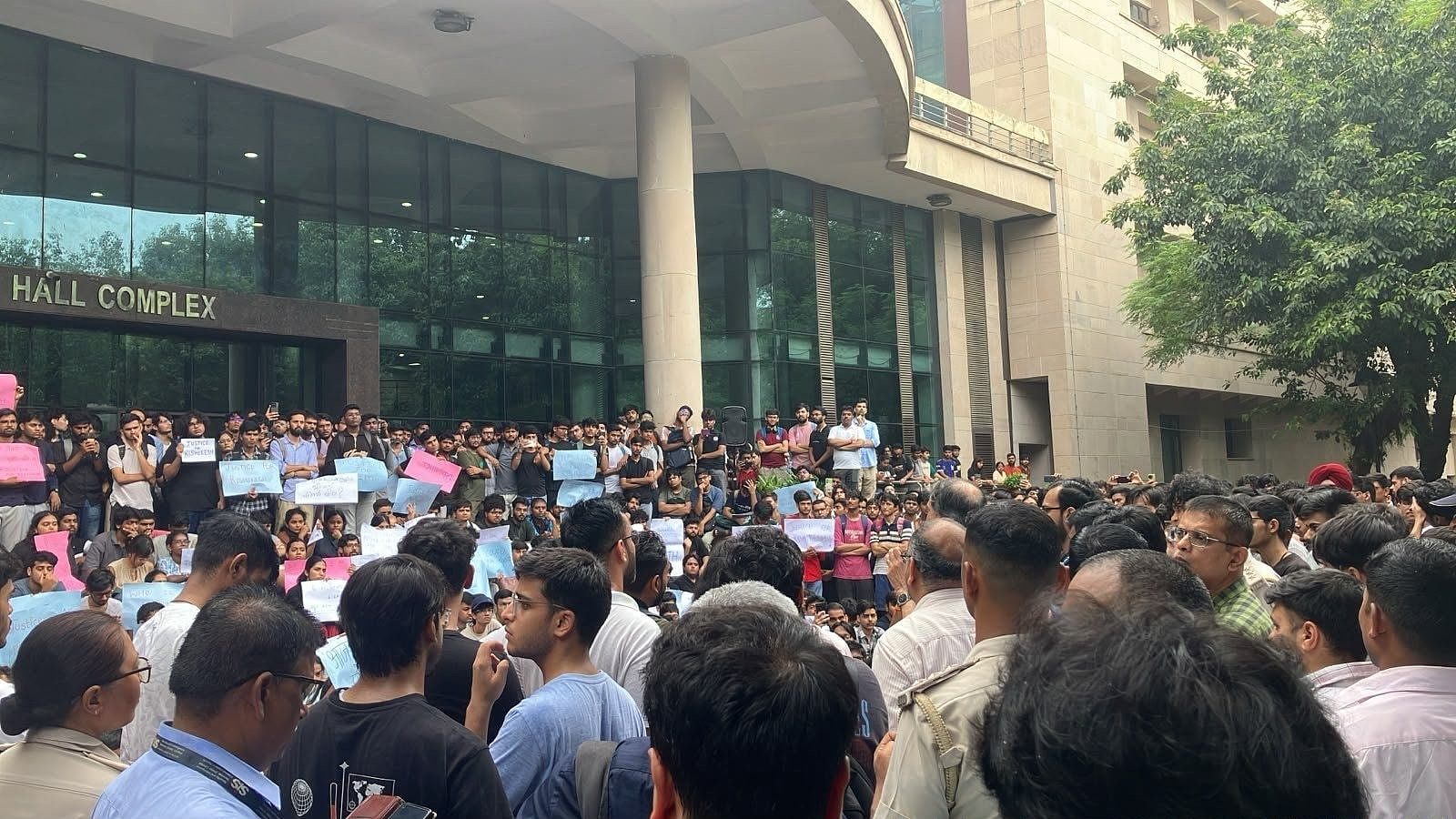
The death of IIT Delhi MSc Physics student Rishikesh Kumar has prompted protests on campus and reignited questions about student welfare at one of India’s premier educational institutions.
بقلم Buzz Staff··74K قراءة
‘Bring Me His Death Certificate’: Former IIT Delhi Student Recalls Professor’s Remark After Grandfather’s Demise, Shares Support With Protestors
The death of IIT Delhi MSc Physics student Rishikesh Kumar has prompted protests on campus and reignited questions about student welfare at one of India’s premier educational institutions.
Amid the outrage, Congress worker and IIT Delhi graduate Shashant Shekhar has shared a deeply personal account of his own experience at the institute, recalling what happened when he returned to campus after the death of his grandfather in 2011.
Shekhar said he was 20 years old when his maternal grandfather died in Patna. He travelled home by train, attended the cremation and the subsequent rituals before returning to IIT Delhi, where he had missed two minor examinations.
When he approached a professor to request a re-examination, Shekhar said he received a response that he still remembers years later. According to Shekhar, the professor told him: “You people from Bihar come here on reservation, can’t handle the pressure, then make excuses and kill your grandparents ten times over. Bring me his death certificate.” Shekhar said he had just returned from a cremation. “I was twenty years old. Twenty. I had just come back from a cremation,” he wrote.
The experience became even more difficult because, according to Shekhar, his family was already dealing with serious illness. His father was battling cancer at the time, while his grandmother had died of cancer a few years earlier.
Five months after his grandfather’s death, another death followed. Shekhar recalled standing in an IIT Delhi corridor and being asked to prove that his grandfather had actually died. “I still remember that corridor. I remember the humiliation. I remember the anger. But more than anything, I remember how small and helpless I felt,” he wrote.
He said the Dean’s office eventually resolved the issue, allowing him to sit for the examination. He graduated from IIT Delhi in three years. Despite the painful memory, Shekhar made it clear that he does not dismiss the role the institute played in his life. “IIT Delhi gave me a platform I could never have had otherwise. I will always be grateful for that,” he wrote. But he immediately added: “But gratitude does not require silence.”
‘A machine that never learned how to measure grief’
Connecting his experience to the protests following Rishikesh Kumar’s death, Shekhar said students had used the phrase “administrative indifference” to describe what they were experiencing.
He said he understood the phrase because of his own experience. “It is a machine. A machine that knows how to measure CGPAs, cut-offs, placement packages, rankings and deadlines. But somehow never learned how to measure grief,” Shekhar wrote. He argued that institutions need to recognise that students can be dealing with circumstances that cannot be reduced to academic records or administrative paperwork.
“Never learned that sometimes, before asking for a certificate, you simply ask: ‘Are you okay?’” he wrote.
Shekhar also pointed to the reported number of student deaths at IIT Delhi and across the IIT system, arguing that repeated tragedies should lead to more than inquiries and statements.
“Every year, our brightest children fight their way into these institutions. And some of them don’t make it out,” he wrote.
He added that institutions often respond by announcing an inquiry, forming a committee and eventually moving on.
“We cannot keep doing this,” he said.
His two demands
Shekhar proposed two immediate measures.
The first was mandatory sensitivity training for faculty and administrative staff. He argued that students dealing with grief or distress may first encounter a professor, section officer or hostel official rather than a counsellor.
“In thirty seconds, that person can make a grieving student feel like a human being or like an inconvenience,” he wrote.
His second demand was for substantially greater access to counsellors.
2011 – My nanaji died in Patna.
I took the train home. I watched my Mama light his pyre. I sat through the rituals. I missed two minor exams at IIT Delhi.
When I returned to campus, I went to ask for a re-exam.
A professor looked at me and said: “You people from Bihar come… https://t.co/Lh8JbUAnVN pic.twitter.com/V89WXBAFFB
— Shashant Shekhar (@ShashantShekhar) August 25, 2026
Shekhar argued that one or two counsellors serving thousands of students does not amount to a functioning mental-health support system. “Hire enough counsellors. Make them permanent. Make them accessible,” he wrote.
He also called for students seeking help to have someone available within days rather than being left waiting for weeks. ‘I never want another twenty-year-old to feel the way I did’
For Shekhar, the current controversy at IIT Delhi is therefore personal. He said his criticism comes not from a desire to dismiss the institution, but precisely because of his connection to it. “I owe IIT Delhi a great deal. That is precisely why I am saying this,” he wrote. And he ended with the memory that appears to have stayed with him for more than a decade: “Because I remember that corridor. And I never want another twenty-year-old, standing there after a funeral, to feel the way I did. Not at IIT Delhi. Not anywhere.”