IIP Growth Accelerates To 8% In August As Manufacturing, Electricity Drive Output
IIP Data for August 2026: India’s industrial production growth accelerated to 8 per cent year-on-year in August, registering its strongest pace in several months, as robust manufacturing activity and a sharp increase in
بقلم Business Desk··19K قراءة
IIP Growth Accelerates To 8% In August As Manufacturing, Electricity Drive Output
IIP Data for August 2026: India’s industrial production growth accelerated to 8 per cent year-on-year in August, registering its strongest pace in several months, as robust manufacturing activity and a sharp increase in electricity generation offset a contraction in mining output, according to government data released on Monday.
The Index of Industrial Production (IIP) grew at a revised rate of 7.4 per cent in July, exceeding market expectations and signalling continued strength in factory activity.
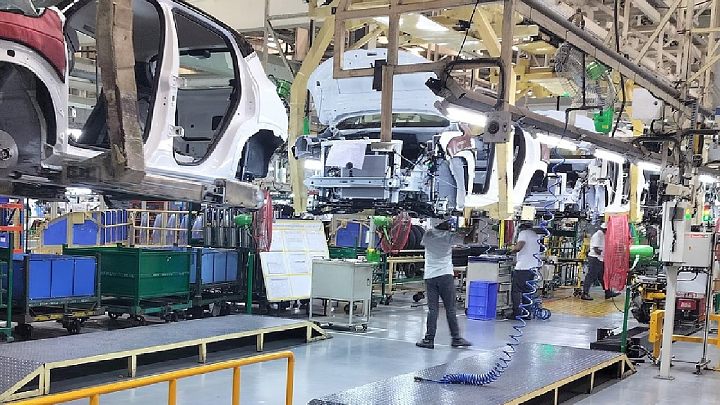
Manufacturing output, which accounts for the largest share of the industrial index, expanded 9 per cent in August, compared with a revised 8.2 per cent growth in July. Electricity generation rose 12.3 per cent, while mining and quarrying output contracted 5.6 per cent.
“In a record performance, manufacturing sector recorded growth of 8 per cent or more in the last three consecutive months,” the statistics ministry said.
Manufacturing, Electricity Drive August IIP Growth
The manufacturing sector remained the primary engine of industrial growth, with 18 out of 23 industry groups registering an increase in production during August.
Motor vehicles, electrical equipment and other transport equipment were among the strongest performers, recording year-on-year growth of 25.2 per cent, 30.9 per cent and 25.3 per cent, respectively.
The latest figures mark the fifth monthly IIP release under India’s revised industrial production series, which uses producer prices to measure factory output instead of wholesale prices under the previous methodology.
Among the use-based categories, consumer durables production, covering products such as automobiles and mobile phones, increased 11.1 per cent in August.
Consumer non-durables, including food products and toiletries, grew 2.1 per cent, recovering from a revised contraction of 0.8 per cent in July.
Capital goods output climbed 16.9 per cent, while intermediate goods production rose 13.7 per cent. Infrastructure and construction goods recorded growth of 6.4 per cent, pointing to an improvement across multiple segments of the industrial economy.
During April-August, the first five months of the current financial year, industrial output expanded 6.7 per cent, compared with 4.2 per cent in the corresponding period of the previous year.
IIP Growth Picks Up In Q2, But Risks Remain
Economists said the latest numbers indicate a broad-based improvement in industrial activity during the second quarter, supported by domestic consumption and export demand.
“IIP averaged 7.7 per cent in July and August, up from 6.2 per cent in the first quarter,” said Dipti Deshpande, principal economist at Crisil.
Manufacturing continued to lead the expansion, followed by electricity generation, while growth in capital goods, intermediate goods and consumer durables pointed to improving activity beyond consumer-facing industries.
However, industrial growth could moderate in the second half of the financial year as higher input costs, elevated interest rates and softer global demand weigh on production, Deshpande said.
Rising crude oil prices and other industrial input costs following the conflict in West Asia could further strain factory output and corporate profitability.
On the domestic front, concerns over the monsoon, agricultural production and rural incomes could affect consumption demand.
Recent high-frequency indicators have pointed to some moderation in rural demand. Two-wheeler sales growth slowed to 10.9 per cent in August from an average of 20.6 per cent in the first quarter. Tractor sales growth declined to 0.8 per cent from 21.7 per cent during the April-June period.
Record Heat, Below-Normal Rainfall Boost Electricity Output
Electricity generation was another significant contributor to August’s industrial production growth. According to Crisil, electricity output received support from unusually warm weather and below-normal rainfall. August 2026 was the hottest August on record, while rainfall remained 16 per cent below normal.
Deshpande expects India’s economic growth to ease to 7 per cent in the current financial year, compared with 7.8 per cent in the previous year.
Government capital expenditure and cash transfers by state governments, however, could continue to support investment and household demand.
While the August industrial production data indicates that the economy maintained strong momentum at the beginning of the second quarter, elevated energy prices, domestic demand uncertainties and weaker global conditions remain key risks to the growth outlook for the remainder of the financial year.