Beyond Onions: Mobile Tariffs, Memory Chip Input Costs Push Up Inflation, HDFC Says
India’s inflation story is showing signs of broadening beyond food prices, with higher mobile tariffs and rising costs of electronic goods adding to price pressures in August, according to a report by HDFC Bank.
بقلم Shankhyaneel Sarkar··35K قراءة
Beyond Onions: Mobile Tariffs, Memory Chip Input Costs Push Up Inflation, HDFC Says
India’s inflation story is showing signs of broadening beyond food prices, with higher mobile tariffs and rising costs of electronic goods adding to price pressures in August, according to a report by HDFC Bank.
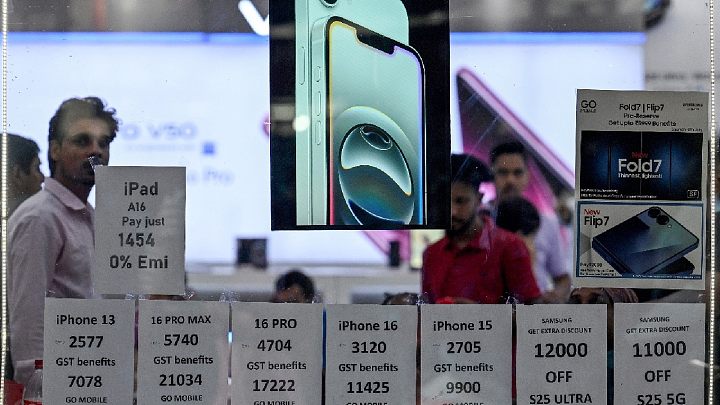
The report said inflation in the information and communication category rose 1.4% month-on-month in August, driven by higher mobile tariffs and a rise in prices of electronic goods, including mobile phones, computers and hard disks.
“This could be explained by the pass-through of higher memory chip prices (experienced globally) to the end consumers,” the report authored by Sakshi Gupta, Principal Economist, and Deepthi Mathew, Senior Economist, said.
The rise in memory-chip prices comes amid a sharp expansion in the global semiconductor market, with artificial intelligence demand and strong memory prices emerging as key drivers.
Global semiconductor revenue surpassed $425 billion in the second quarter of 2026, reaching another all-time high, while the market grew a record 31.4% quarter-on-quarter, according to new research from Omdia. AI demand and strong memory prices remained the leading market dynamics, taking total semiconductor revenue for the first half of 2026 to $752 billion.
The memory market, led by dynamic random-access memory (DRAM) and NAND flash memory, has continued to expand as AI demand reshapes memory suppliers’ production priorities.
These shifts in production are affecting supply-demand balances, resulting in higher average selling prices and revenue, according to the Omdia research. Memory integrated circuits accounted for more than half of all semiconductor revenue in the second quarter of 2026.
Against this backdrop, HDFC Bank said India’s core CPI inflation rose to 4.2% in August from 3.9% in July. Core inflation excluding gold and silver also increased to 2.9% from 2.7%, indicating that higher input costs are increasingly being passed on to consumers.
The report said the increase in core inflation was broad-based, with sequential price increases seen in information and communication, restaurants and accommodation, household equipment and furnishing, and personal care segments.
HDFC Bank also flagged continuing price pressures in some food items. “As per the daily data from Department of Consumer Affairs, the price pressure in sugar, cereals and vegetables continue to mount in September till date,” the report said.
Food inflation in India, which was roughly 6% in August, is unlikely to persist towards the end of the year, Chief Economic Adviser V Anantha Nageswaran said on Tuesday, adding that a shortfall in monsoon was “manageable” and crop output was expected to be good.
Food and beverages account for 36.75% of India’s consumer price index basket, which is used to measure retail inflation.
Nageswaran also said global risks had resurfaced, while the Indian economy was likely to remain resilient. He said uncertainties had returned following developments in the Middle East over the past five days, and it remained to be seen whether the economy could ride through them as it had between March and July.
HDFC Bank also said fuel inflation rose to 3.1% year-on-year in August, registering a sequential increase of 0.3%. The increase was mainly driven by higher coal and firewood prices, it said.
The bank expects India’s CPI inflation to remain elevated in the coming quarters, estimating headline inflation at 5.1% for FY27, with inflation expected to reach 6% in the third quarter and 5.8% in the fourth quarter. It said risks were tilted to the upside as higher input costs, elevated global commodity prices and increased food-price volatility could add to inflationary pressures.
HDFC Bank expects the Reserve Bank of India to remain in a wait-and-watch mode at its October policy meeting, although it expects the central bank’s tone to be hawkish.
“We continue to expect the RBI to remain in wait and watch mode in the October policy, although expect the tone to be hawkish,” the report said. HDFC Bank expects the RBI to begin a rate-hiking cycle from December 2026 onwards.