12 Years, 7 Numbers: On PM Modi's 76th Birthday, Know India's Growth Story Since 2014
Prime Minister Narendra Modi turns 76 on Thursday, September 17, marking more than 12 years since he took office as the country’s prime minister. Over this period, India’s economy has undergone significant changes across
بقلم Business Desk··36K قراءة
12 Years, 7 Numbers: On PM Modi's 76th Birthday, Know India's Growth Story Since 2014
Prime Minister Narendra Modi turns 76 on Thursday, September 17, marking more than 12 years since he took office as the country’s prime minister. Over this period, India’s economy has undergone significant changes across output, financial inclusion, infrastructure, digital payments and entrepreneurship.
India has also faced major disruptions during this period, including the Covid-19 pandemic, global trade tensions, commodity price shocks and geopolitical uncertainties. Yet, several economic indicators have expanded substantially compared with the 2014 baseline.
Here are seven numbers that capture some of the key changes in India’s economic landscape over the past 12 years.
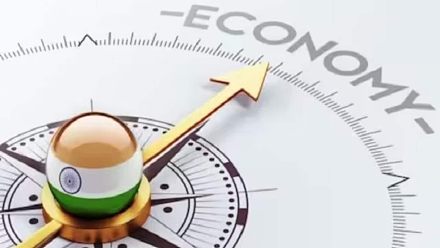
1. $3.96 trillion: India’s GDP
India’s economy has nearly doubled in nominal dollar terms since 2014. World Bank data puts India’s GDP at around $2.04 trillion in 2014. By 2025, it had risen to $3.96 trillion.
The latest data also shows the pace of economic expansion remains strong. India’s real GDP grew 7.8% in the April-June quarter of FY27, beating the Reserve Bank of India’s earlier projection of 7%. Growth was supported by investment, manufacturing, services and domestic demand.
The World Bank’s latest data shows India recorded 7.6% annual GDP growth in 2025, compared with global growth of 2.9%. India’s GDP per capita has also increased, rising from around $1,574 in 2014 to $2,702.5 in 2025, according to World Bank data.
2. $785.7 billion: Forex reserves
India’s external financial buffer has expanded sharply. Foreign exchange reserves stood at $304.2 billion at the end of March 2014, according to government data. By the week ended September 4, 2026, reserves had reached a record $785.7 billion, according to RBI data. That means the stock of reserves is now more than 2.5 times the level seen in 2014.
The larger reserve pool gives the country a bigger cushion against external shocks, including sudden movements in global capital flows, commodity prices and the rupee.
3. 59.21 crore: Jan Dhan accounts
One of the biggest changes has been in access to formal banking. The Pradhan Mantri Jan Dhan Yojana, launched in 2014, was aimed at bringing unbanked households into the formal financial system. As of September 2, 2026, the number of beneficiaries under the scheme stood at 59.21 crore.
Deposits in these accounts had reached Rs 3.17 lakh crore, while 41.39 crore RuPay debit cards had been issued. Women accounted for 32.98 crore beneficiaries, while 46.03 crore beneficiaries were at rural and semi-urban bank branches.
The expansion of bank accounts has also provided the infrastructure for direct benefit transfers and greater use of formal digital financial services.
4. 146,572 km: National highway network
India’s physical infrastructure has also expanded considerably. The national highway network stood at 91,287 km in FY14. By December 2025, it had increased to 146,572 km, a rise of around 60%, according to the Economic Survey 2025-26.
The pace of construction has also accelerated. Average annual national highway construction increased from 4,174 km during 2004-14 to 9,704 km during 2014-25, according to the Economic Survey.
High-speed connectivity has expanded as well. The Economic Survey said operational high-speed corridors increased from 550 km in FY14 to 5,364 km by December 2025.
5. 24.51 billion: Monthly UPI transactions
India’s financial system has not only expanded in terms of bank accounts but has also become increasingly digital. The Unified Payments Interface, launched in 2016, processed a record 24.51 billion transactions in August 2026, worth Rs 29.82 lakh crore, according to NPCI data.
That translates into an average of nearly 79 crore UPI transactions a day during the month. UPI has become a major part of India’s retail payments infrastructure, allowing consumers and businesses to transfer money instantly using bank accounts and mobile phones. The scale of the system today is a sharp contrast with the cash-heavy payments landscape of the middle of the last decade.
6. 2.47 lakh: Recognised startups
India’s entrepreneurial ecosystem has expanded dramatically over the past decade. DPIIT-recognised startups increased from 502 in 2016 to more than 2.47 lakh by August 2026.
The government describes India as the world’s third-largest startup ecosystem. The rise has been accompanied by a broader policy push around startup funding, incubation, digital incorporation and regulatory approvals. The National Single Window System, for instance, now integrates approvals across 32 Central ministries and 34 states.
The startup numbers do not by themselves measure the commercial success or survival of individual companies, but they do show the considerable expansion in the formal startup-recognition ecosystem since the launch of Startup India.
7. $2.04 trillion to nearly $4 trillion: A larger economic base
Taken together, these numbers point to a broader change in the scale of the Indian economy. India’s nominal GDP has risen from about $2.04 trillion in 2014 to $3.96 trillion in 2025, while forex reserves have increased from $304.2 billion to a record $785.7 billion. The national highway network has expanded by about 60%, Jan Dhan has brought nearly 60 crore beneficiaries into the banking system, and UPI now processes more than 24 billion transactions a month.