This Delhi Teen's ₹140 Innovation Turned Classroom Fans Into Air Purifiers, Helping 10,000 Schoolchildren Breathe Cleaner Air
In Delhi, where air pollution regularly becomes a winter headline, clean air inside classrooms is not something every child can take for granted. While well-funded schools may be able to invest in expensive air purifiers
بقلم Swati Chaturvedi··21K قراءة
This Delhi Teen's ₹140 Innovation Turned Classroom Fans Into Air Purifiers, Helping 10,000 Schoolchildren Breathe Cleaner Air
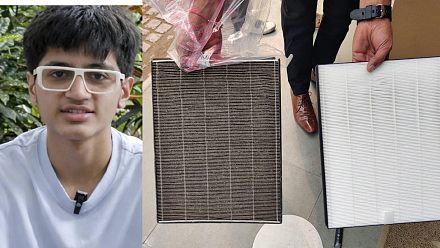
In Delhi, where air pollution regularly becomes a winter headline, clean air inside classrooms is not something every child can take for granted. While well-funded schools may be able to invest in expensive air purifiers, many government and underprivileged schools have to make do with ordinary ceiling and wall fans. A group of Delhi students decided to tackle precisely this gap, and their solution is remarkably simple: turn the fans already installed in classrooms into air purifiers.
The initiative, called Project Vayu, was co-founded by Krish Aggarwal and Samarth Meattle. Its low-cost retrofit filter is designed to attach to existing fans and capture fine particulate matter, including PM2.5. The project has now reached more than 10,000 schoolchildren in Delhi, and Aggarwal’s work has earned him a place on the 2026 Diana Award Roll of Honour.
For a city where children spend several hours a day inside classrooms, the idea addresses a problem that often receives less attention than outdoor air pollution. While AQI readings and smog-filled skies dominate conversations, indoor exposure can also be a concern, particularly in schools without dedicated air filtration systems.
The idea began with a question about classroom air
Project Vayu grew out of a fairly straightforward observation: schools that needed cleaner indoor air the most were often the least equipped to afford conventional air purifiers.
Commercial air-cleaning systems can be expensive, and installing separate units in every classroom can be difficult for schools operating with limited budgets. The students wanted to find a solution that would not require schools to purchase an entirely new appliance.
The answer was to work with what classrooms already had.
The project was built around a simple premise: if a regular fan could circulate air through an appropriately designed filter, it could also help capture airborne particulate matter. The team worked with Hollingsworth & Vose, a global filtration manufacturer headquartered in Massachusetts, on research and development to create the Vayu Filter.
The collaboration also involved a supply of 700 metres of sponsored filter media, helping the students develop their design into a practical product.
How does a regular fan become an air purifier?
The Vayu Filter uses electret filter media, a material containing electrostatically charged fibres that attract and capture fine airborne particles.
Unlike a conventional standalone air purifier, the filter does not require its own motor. It is fitted over an existing wall or table fan using an elastic lining, without the need for tools, adhesives or complicated installation.
When the fan is switched on, the airflow causes the filter to expand into a balloon-like shape. This increases the available filtration surface area to more than five square feet, according to Project Vayu.
As air moves through the filter material, particulate matter gets trapped within it. The system is designed to capture PM2.5, the fine particles that are small enough to penetrate deep into the respiratory system.
The installation process is also deliberately uncomplicated. The team says a filter can be fitted in less than a minute, making it easier for schools to adopt the technology without requiring specialised technicians.
A filter that costs approximately ₹140
Perhaps the most interesting part of Project Vayu is its cost structure. According to the initiative, each filter costs approximately ₹140 to manufacture, including the filtration material, elastic lining, stitching and transportation. Schools receive the filters free of charge. Where a classroom does not have a suitable fan, the team also provides one.
The model is built around accessibility rather than selling an expensive product to schools.
The project’s pilot covered 295 classrooms, with 602 filters installed and more than 8,000 students reached. Its website also outlines plans to expand to another 45 schools in New Delhi.
Project Vayu has reported promising results from its own closed-room testing. In a room measuring approximately 168 square feet, the PM2.5 concentration was recorded at 158 micrograms per cubic metre before the filter was switched on. After 60 minutes, the reading had fallen to 11 micrograms per cubic metre, representing a reduction of more than 90 per cent.
These are project-reported test results rather than proof of equivalent performance in every classroom. Actual filtration will depend on factors such as room size, ventilation, fan speed, filter condition and the level of pollution entering the space.
Nevertheless, the approach offers an interesting alternative for schools that may otherwise have no filtration system at all.
Why classroom air quality deserves attention
Children spend a significant part of their day inside school buildings, often for six hours or more. This makes indoor air quality an important part of the wider conversation around public health and education.
PM2.5 refers to fine particulate matter with a diameter of 2.5 micrometres or less. These particles can originate from vehicle emissions, construction dust, industrial activity, burning and other sources of pollution.
Because of their small size, they can travel deep into the lungs. Exposure to high concentrations of fine particulate matter is associated with respiratory and cardiovascular health risks.
The World Health Organization’s air quality guidelines recommend an annual average PM2.5 concentration of 5 micrograms per cubic metre and a 24-hour average of 15 micrograms per cubic metre.
While an affordable fan-mounted filter cannot solve Delhi’s outdoor pollution problem, it represents an attempt to address one part of the issue: the air children breathe inside their classrooms.
It is also important to remember that filtration works best alongside adequate ventilation and measures to reduce pollution at its source.
What the 2026 Diana Award means for Project Vayu
Aggarwal’s work has now received international recognition through the 2026 Diana Award, which honours young people for social action and humanitarian work.
Established in memory of Diana, Princess of Wales, the award recognises individuals who demonstrate leadership, compassion and a sustained commitment to improving the lives of others.
The 2026 Roll of Honour features 198 young changemakers from 44 countries, including 49 recipients from India. Project Vayu’s inclusion reflects the growing recognition of young people developing practical responses to environmental and social challenges.
The award profile specifically highlights Aggarwal’s contribution to making clean air more accessible to children in schools with limited resources, as well as his efforts to promote evidence-based environmental solutions and youth-led climate action.
For Project Vayu, the recognition also brings attention to an issue that extends beyond one city or one school system. Access to cleaner indoor air should not depend entirely on whether a school can afford expensive equipment.
A small innovation addressing a much bigger problem
What makes Project Vayu interesting is its approach to problem-solving. Instead of creating another expensive appliance, the students looked at an existing resource and explored how it could be made more useful.
A classroom fan, something that would ordinarily only circulate air, becomes part of a filtration system. A filter costing approximately ₹140 is distributed without charge to schools that need it. And an initiative that began with a concern about children’s exposure to polluted air has grown into a project reaching thousands of students.
Delhi’s air pollution crisis will require much larger interventions involving transport, construction, industry and public policy. A fan-mounted filter is not a substitute for those measures.
But Project Vayu offers a reminder that young people do not always have to wait for large institutions to act before they can contribute to a solution. Sometimes, a meaningful idea begins with looking at something as ordinary as a classroom fan and asking what more it could do.