Ramayana: How The Team Built Ravana’s Rs 1 Crore Throne In Just 4 Months
With Ramayana now in theatres, audiences are getting a glimpse of the cinematic world that director Nitesh Tiwari and producer Namit Malhotra have been painstakingly putting together. Starring Ranbir Kapoor as Lord Ram,
بقلم Lifestyle Desk··7K قراءة
Ramayana: How The Team Built Ravana’s Rs 1 Crore Throne In Just 4 Months
With Ramayana now in theatres, audiences are getting a glimpse of the cinematic world that director Nitesh Tiwari and producer Namit Malhotra have been painstakingly putting together. Starring Ranbir Kapoor as Lord Ram, Sai Pallavi as Sita and Yash as Ravana, the ambitious two-part adaptation brings one of India’s most celebrated epics to life with considerable attention to visual grandeur.
And if there is one part of the Ramayana that audiences have been particularly eager to see unfold on the big screen, it is undoubtedly Sone Ki Lanka. The fabled kingdom of gold, with its magnificent architecture, lavish interiors and the unmistakable extravagance of Ravana’s court, presents an enormous opportunity for visual spectacle.
After all, Sone Ki Lanka is not just another mythical setting; it is a world many of us have grown up imagining through stories, illustrations, television adaptations and countless retellings of the epic. Its golden palaces, towering structures and the sheer magnificence of Ravana’s kingdom have occupied our collective imagination for generations.
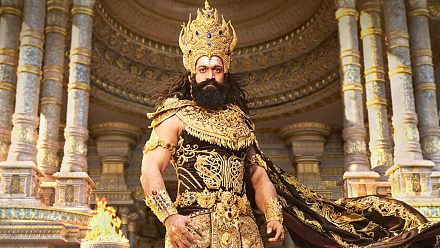
Translating that childhood imagination into a sprawling cinematic universe is no small feat. And while the grand sets and elaborate production design contribute to building this mythical world, it is the finer details that bring its characters to life. For Ravana, played by Yash, that means an appearance befitting the formidable king of Lanka, complete with an elaborate crown, statement jewellery and intricate adornments that reflect his power, wealth and larger-than-life persona.
The jewellery and accessories created for the character are an exercise in craftsmanship in their own right. From the design inspiration and traditional motifs to the painstaking work of artisans, here’s a closer look at how the makers of Ramayana approached Ravana’s royal appearance.
Ramayana: The Design Inspiration Behind Ravana’s Royal Look
Ravana’s appearance in Ramayana was envisioned around one defining idea: opulence. As the ruler of Lanka, a kingdom celebrated in mythology for its extraordinary wealth and golden splendour, his jewellery and accessories needed to reflect an unmistakable sense of power and abundance.
Speaking to NDTV, Tarang Arora, Creative Head of House of Amrapali, explained that the creative brief was rooted in the belief that Lanka was built of gold. This became an important starting point for developing Ravana’s jewellery, with the designers exploring how to translate the kingdom’s legendary richness into wearable pieces.
The objective was not simply to pile on gold and embellishments. Each element needed to complement Ravana’s personality, his royal stature and his association with Lord Shiva. The resulting visual language combined traditional motifs, elaborate detailing and a striking colour palette to create an appearance befitting the king of Lanka.
Inside Ravana’s Elaborate Jewellery Collection
The jewellery created for Yash’s portrayal of Ravana was an extensive exercise in design and craftsmanship. Tribe Amrapali reportedly created 13 distinct jewellery looks for the character, with each look comprising eight to 10 individual pieces. That brought the total number of pieces to approximately 104-130.
Each complete jewellery look weighed between 6 and 7 kg, making the ensemble as demanding to wear as it was elaborate to create.
Among the most challenging pieces was Ravana’s chest plate, which was entirely handcrafted by artisans. The designers also had to consider the practicalities of making Yash wear the elaborate ensemble during extended shooting schedules. Soft linings were incorporated underneath the chest plate to make it more comfortable, ensuring that the weight and rigidity of the ornamentation did not become an unnecessary hindrance during filming.
Snake Motifs, Gold And The Details Behind Ravana’s Look
Beyond the sheer quantity of jewellery, it was the detailing that helped establish Ravana’s distinct visual identity. Snake motifs were incorporated into the designs as a reference to his devotion to Lord Shiva, while darker shades of blue, black and green complemented the brass and gold-plated elements.
The interplay of these colours and materials was important in creating a look that went beyond conventional royal ornamentation. The darker accents added depth to the gold, while the intricate motifs gave the pieces a stronger connection to Ravana’s mythological identity.
The jewellery was therefore designed to do more than accessorise the character. It became an extension of his personality, beliefs and authority, helping establish the visual language of a ruler whose presence was meant to command attention.
For a story as deeply embedded in India’s cultural imagination as the Ramayana, recreating its characters comes with enormous expectations. Their appearances are already familiar to generations of audiences.
And as audiences experience the world of Lanka on the big screen, it is these carefully crafted details, from the elaborate adornments to the unmistakable grandeur of Ravana’s royal appearance, that help make the mythical king’s cinematic transformation all the more compelling.