Patrick Stewart Dies At 86 After Battling Alzheimer’s And Lewy Body Dementia: What To Know
Sir Patrick Stewart, the British actor best known for playing Jean-Luc Picard in Star Trek: The Next Generation and Professor Charles Xavier in the X-Men franchise, died at the age of 86 on October 28. A statement shared
بقلم Lifestyle Desk··8K قراءة
Patrick Stewart Dies At 86 After Battling Alzheimer’s And Lewy Body Dementia: What To Know
Sir Patrick Stewart, the British actor best known for playing Jean-Luc Picard in Star Trek: The Next Generation and Professor Charles Xavier in the X-Men franchise, died at the age of 86 on October 28. A statement shared by his family said he had experienced a “brief and poignant journey” with Alzheimer’s disease and Lewy body dementia before his death.
A family statement said he passed away at his Los Angeles home “following a brief and poignant journey with Alzheimer’s disease and Lewy body dementia,” while in the care of his wife Sunny and surrounded by family and friends.
Stewart had not publicly disclosed his diagnoses before his death. The combination of the two conditions is sometimes referred to as mixed dementia. Both are progressive neurodegenerative disorders that affect memory, thinking and daily function, yet they differ in important ways.
Image credits: AFP
Although Alzheimer’s disease and Lewy body dementia are both associated with dementia, they are distinct conditions and can sometimes occur together.
What Is Lewy Body Dementia?
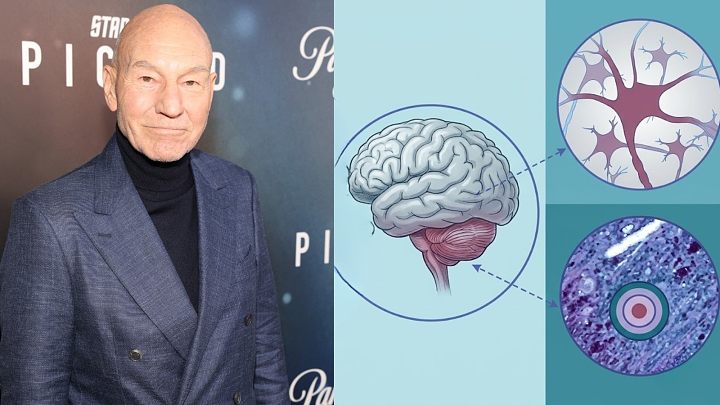
Lewy body dementia (LBD) is the second most common form of progressive dementia after Alzheimer’s disease. It is caused by abnormal clumps of a protein called alpha-synuclein known as Lewy bodies that build up inside brain cells. These deposits damage areas involved in thinking, memory and movement.
Unlike Alzheimer’s, which is primarily marked by difficulty forming new memories, people with LBD may be able to form new memories but struggle to retrieve them. Cognitive abilities can also fluctuate dramatically from day to day or even hour to hour. Other characteristic features include detailed visual hallucinations, movement problems that resemble Parkinson’s disease, and sleep disturbances such as acting out dreams (REM sleep behaviour disorder). Some patients develop what clinicians call the “Lewy lean,” a tendency to lean to one side when sitting, standing or walking, along with balance difficulties and increased falls.
Image: Research Gate
Early Signs Of Lewy Body Dementia
Memory loss can occur in LBD, but it is not always the first or most prominent symptom. Early changes may instead involve attention, alertness, visual perception, movement or problem-solving.
People with LBD can experience significant fluctuations in alertness, sometimes appearing relatively clear at one point and confused or unusually drowsy later. Visual hallucinations can also occur. Other possible symptoms include stiffness, tremors, slowed movement and changes associated with sleep.
One particularly recognised feature is REM sleep behaviour disorder, in which a person may physically act out dreams, including shouting, kicking or moving during sleep. Anxiety may also occur during the early stages of the disease.
How Is Lewy Body Dementia Different From Alzheimer’s Disease?
Alzheimer’s disease is the most common cause of dementia. It involves the accumulation of beta-amyloid plaques and tau tangles in the brain. Early symptoms typically centre on memory loss, word-finding difficulty and problems with reasoning and judgement. As the disease advances, cognitive and functional decline becomes more severe.
Alzheimer’s commonly begins with memory problems and can eventually affect language, reasoning, judgement and the ability to perform everyday activities. The disease is associated with abnormal biological processes involving proteins such as amyloid and tau.
Image: Canva
LBD, meanwhile, can have a stronger early impact on attention, visual-spatial abilities, movement, sleep and alertness. The pattern can fluctuate considerably, making the condition particularly challenging to identify.
When Should Dementia Symptoms Be Evaluated?
Persistent or worsening changes in memory, thinking, movement, sleep, behaviour or perception warrant medical evaluation, particularly in older adults. Symptoms such as recurrent visual hallucinations, unexplained changes in alertness, dream enactment or new movement problems can be important information for a doctor assessing possible LBD.
A neurologist or another clinician experienced in evaluating cognitive disorders can assess symptoms, medical history and functional changes and determine whether further testing is needed. Early assessment can also help families understand what support and treatment options may be appropriate.
Stewart’s family described his final period as one of dignity, surrounded by music, prayer, laughter and the people who loved him. His death draws attention once again to the complex realities of living with, and caring for someone with, these forms of dementia.