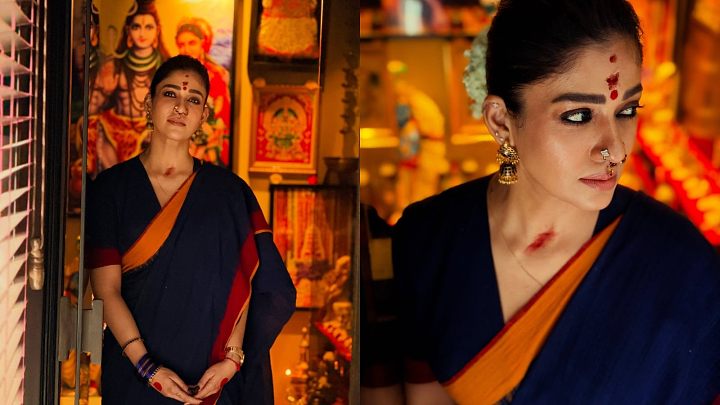
With just days to go before Mookuthi Amman 2 hits theatres, Nayanthara is turning to divine blessings ahead of her next big-screen outing. The actor-producer visited Chennai’s historic Kalikambal Kamadeswarar Temple on N
With just days to go before Mookuthi Amman 2 hits theatres, Nayanthara is turning to divine blessings ahead of her next big-screen outing. The actor-producer visited Chennai’s historic Kalikambal Kamadeswarar Temple on November 3, where she performed a special puja ahead of the film’s November 6 theatrical release.
And for the occasion, she arrived looking every bit the picture of elegance. Nayanthara picked a deep navy blue saree, giving it a vibrant lift with a mustard-orange border and a striking magenta-red edge. Gold jhumkas, a delicate nose ring, stacks of blue-and-gold bangles and a jasmine-adorned bun brought the look together, while her kohl-rimmed eyes and bold red tilak added to the classic temple-visit aesthetic.
(Image: Instagram/@nayanthara)
Located on Thambu Chetty Street in George Town, the Kalikambal Temple is dedicated to Goddess Kalikambal, a form of Goddess Parvati, and Lord Kamadeswarar. Its history stretches back several centuries, and its stories bring together powerful deities, revered sages, a legendary Maratha ruler and one of Tamil literature’s most celebrated poets.
From the belief that the goddess was once worshipped in a fierce manifestation to the story of Chhatrapati Shivaji’s visit, there is much more to this temple than meets the eye. Here are five fascinating legends and historical stories you must know with the Kalikambal Temple.
(Image: Instagram/@nayanthara)
1. The Goddess Was Once Worshipped In Her Fierce Form
One of the most intriguing legends associated with Kalikambal Temple concerns the original manifestation of the presiding goddess. According to temple lore, the deity was once worshipped in a fierce form of Goddess Kali, embodying her formidable Shakti energy. The tradition holds that Adi Shankaracharya later transformed this fierce manifestation into a more peaceful form of Goddess Kamakshi.
The story reflects an important aspect of Shakti worship, where the divine feminine represents both formidable power and benevolent protection. Today, devotees worship Goddess Kalikambal as a compassionate and protective mother figure.
2. Chhatrapati Shivaji Once Visited The Temple In 1677
The Kalikambal Temple has an interesting connection with one of India’s most celebrated historical figures, Chhatrapati Shivaji Maharaj. Historical accounts and temple tradition associate the Maratha ruler with a visit to the shrine in 1677, during his southern campaign. A commemorative plaque at the temple marks the visit, while a rare painting and sculpture reportedly depict Goddess Kali blessing Shivaji.
According to a number of popular account, Shivaji was particularly devoted to Goddess Kali. Legend has it that he visited the temple during a night-time reconnaissance after learning that the presiding deity was Kali, a goddess he revered. The association has since become an important part of the temple’s historical identity.
3. The Temple Was Originally Located Near Fort St George
Here’s another fascinating chapter in the temple’s history: the Kalikambal shrine was not always located where devotees visit it today. The temple originally stood closer to the coastline, at the site now associated with Fort St George. When the British East India Company established the fort, the temple had to be relocated to its present location in George Town.
The new temple’s construction began in 1640 and was completed in 1678, according to historical accounts. Despite the change in location, the shrine retained its religious significance and continued to attract devotees. Its relocation is a reminder of how Chennai’s religious landscape evolved alongside the city’s colonial-era development. The temple is also popularly associated with the name Kottaiamman, with ‘Kottai’ referring to the fort near its original location.
4. The Goddess Is Believed To Have Been Worshipped By Ancient Sages
The temple’s spiritual legacy stretches beyond recorded history into mythology. According to a legend highlighted by Incredible India, the presiding deity was revered by demi-gods and several celebrated sages, including Vyasa, Agastya, Angeerasa, Pulastya and Varuna.
These associations add another layer to the shrine’s significance within Hindu traditions. Sage Agastya, for instance, holds an important place in southern Indian spiritual and literary traditions, while Vyasa is revered as the traditional composer of the Mahabharata. Their association with Goddess Kalikambal reflects the belief that the shrine has long been a place of divine worship and spiritual seeking.
5. Tamil Poet Subramania Bharati Found Inspiration At The Temple
The Kalikambal Temple’s cultural legacy extends beyond mythology and royal connections. It also has an association with Subramania Bharati, one of Tamil literature’s most celebrated poets and freedom-era literary figures. According to reports, Bharati sought refuge at the temple, drawing inspiration from its peaceful atmosphere for his poetry.
This connection adds a lovely literary dimension to the shrine’s history. Bharati’s work explored themes of freedom, social change, spirituality and the power of the divine feminine. His association with the temple is particularly interesting given the prominence of Goddess Shakti in his poetry. The shrine, therefore, occupies a place not just in Chennai’s religious history but also in its cultural and literary memory.
As Nayanthara seeks blessings ahead of Mookuthi Amman 2, her visit has offered a timely glimpse into the history of a shrine that has remained an important part of Chennai’s spiritual and cultural landscape.