Bhumi Pednekar Visits Ujjain’s Mahakaleshwar Temple: The Fascinating Mythology Behind This Sacred Jyotirlinga
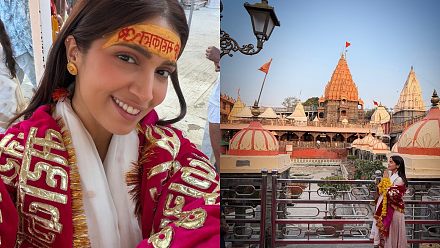
Actress Bhumi Pednekar visited Ujjain’s revered Mahakaleshwar Temple ahead of Diwali to seek the blessings of Lord Shiva. Sharing glimpses of her spiritual visit on Instagram, she wrote, “Just surrender Jai Shri Mahakaal
بقلم Lifestyle Desk··25K قراءة
Bhumi Pednekar Visits Ujjain’s Mahakaleshwar Temple: The Fascinating Mythology Behind This Sacred Jyotirlinga
Actress Bhumi Pednekar visited Ujjain’s revered Mahakaleshwar Temple ahead of Diwali to seek the blessings of Lord Shiva. Sharing glimpses of her spiritual visit on Instagram, she wrote, “Just surrender Jai Shri Mahakaal. Happy Diwali.”
Dedicated to Shiva in his formidable manifestation as Mahakal, the temple is among the twelve revered Jyotirlingas in India. Yet its significance extends well beyond its status as a major pilgrimage destination. Rooted in the Shiva Purana, the shrine is associated with an evocative legend of divine intervention, a demon vanquished by Shiva and a deity who chose to remain in Ujjain as its eternal protector.
The mythology surrounding Mahakaleshwar is as compelling as the rituals that define its worship, from the distinctive south-facing Jyotirlinga to the early-morning Bhasma Aarti. At its heart lies a profound idea, Shiva as Mahakal, the Lord of Time, who presides over mortality while remaining beyond its grasp.
The legend of Mahakal: How Lord Shiva became Ujjain’s eternal protector
The origins of Mahakaleshwar are recounted in the Shiva Purana, where the deity emerges not merely as an object of devotion but as an extraordinary force of divine protection.
(Image: Instagram/@bhumisatishpednekkar)
According to a popular legend, Ujjain was once ruled by King Chandrasena, an ardent devotee of Lord Shiva. A young boy named Shrikhar, deeply moved by the king’s devotion, wished to worship the deity with equal fervour. His enthusiasm, however, was met with resistance, and he was sent away from the city.
In the course of these events, Shrikhar learnt of an impending attack on Ujjain by rival rulers allied with the demon Dushanan. Alarmed by the threat, the boy turned to Shiva in fervent prayer. A priest named Vridhi joined him in invoking the deity’s protection.
As the invading forces threatened the city, Shiva manifested in a terrifying form, vanquished Dushanan and delivered Ujjain from destruction. Moved by the devotion of his worshippers, the deity is believed to have chosen to remain in the city as Mahakaleshwar, its eternal guardian.
The legend establishes the spiritual character of the shrine: Shiva as the protector who intervenes when the forces of destruction threaten to overwhelm the faithful. His manifestation as Mahakal is at once fearsome and reassuring, embodying a divine power that destroys adharma (unrighteousness) while safeguarding those who seek refuge in him.
There is a compelling duality to Shiva in Hindu mythology. He is the ascetic who renounces worldly attachments, the cosmic dancer whose Tandava signifies creation and dissolution, and the formidable deity who intervenes to protect his devotees. At Mahakaleshwar, these aspects converge in a form that commands both reverence and surrender.
Why is Lord Shiva worshipped as Mahakal, the Lord of Time?
The name Mahakal carries a metaphysical significance that extends well beyond its literal translation. Maha means great, while Kaal refers to time and, by extension, death. Together, the name evokes Shiva as the supreme force who governs temporal existence while remaining beyond its limitations.
In Hindu cosmology, Kaal is not simply the passage of hours, days or years. It is the inexorable principle through which creation unfolds, life transforms and every mortal existence eventually reaches its end. Shiva, in his Mahakal form, represents the ultimate reality before which worldly power, material possessions and human achievements are rendered transient.
(Image: Instagram/@bhumisatishpednekkar)
This is also what makes the temple’s mythology particularly resonant. Devotees approach Mahakal seeking protection, strength and blessings for their families, but the deeper philosophical significance lies in the recognition of anitya, impermanence. Everything that takes form is subject to change; nothing in the material world remains untouched by time.
Shiva, however, is understood in Shaivite philosophy as transcending this temporal cycle. The deity is therefore worshipped not merely as the master of death, but as a source of spiritual refuge for those confronting the uncertainties of existence.
Ujjain’s historical association with astronomy, calendrical traditions and the measurement of time adds another dimension to the city’s spiritual identity. The relationship between Mahakal and time is thus woven into both religious imagination and Ujjain’s wider cultural heritage.
What makes Mahakaleshwar one of the twelve Jyotirlingas so special?
The twelve Jyotirlingas occupy an exalted position in Hindu worship, representing sacred manifestations of Lord Shiva across the Indian subcontinent. The word Jyotirlinga combines jyoti, meaning light or radiance, with linga, the symbolic representation of Shiva.
According to a foundational legend in Shaivite tradition, Shiva once revealed himself as an infinite pillar of light, challenging Brahma and Vishnu to discover its beginning and end. Neither deity could establish its limits. The episode illustrates a central tenet of Hindu philosophy: the supreme reality is ananta, infinite, without beginning or end, and beyond the boundaries of ordinary human comprehension.
Mahakaleshwar holds a distinctive place among these sacred shrines for two reasons.
(Image: Instagram/@bhumisatishpednekkar)
The south-facing Jyotirlinga: Mahakaleshwar is traditionally recognised as the only south-facing Jyotirlinga among the twelve and is known as Dakshinamukhi. The south carries associations with Yama, the deity of death, lending particular resonance to Shiva’s identity as Mahakal, the force that presides over mortality. This orientation contributes to the shrine’s distinctive religious significance.
The self-manifested lingam: The presiding deity is revered as Swayambhu, meaning self-manifested. Unlike a form understood solely through human installation, a Swayambhu lingam is believed to have emerged through its own divine presence. For devotees, this lends the shrine a particular sanctity, reinforcing the belief that Mahakal’s presence in Ujjain is eternal.
Bhasma Aarti: The profound symbolism behind Mahakaleshwar’s most distinctive ritual
Few rituals associated with Lord Shiva are as evocative as the Bhasma Aarti at Mahakaleshwar. Performed in the early hours of the morning, this ceremony is among the temple’s most distinctive religious observances, drawing devotees who wish to witness an important expression of Shaivite worship.
The word bhasma means ash, while aarti refers to a ritual of worship involving the offering of light and prayers. At Mahakaleshwar, the ceremony carries a symbolism that reaches deep into the philosophical foundations of Shiva worship.
Shiva is frequently depicted with ash smeared across his body, his matted locks crowned by the crescent moon and the Ganga flowing from his hair. Unlike conventional images of royal or worldly splendour, this iconography places him in the realm of the ascetic, detached from material possessions and untroubled by social conventions.
Ash, in this context, becomes a reminder of nashvarata, the transient nature of physical existence. The body, beauty, wealth, status and worldly achievements eventually return to the elements. Bhasma brings this truth into sharp focus, stripping away the illusion that material distinctions are permanent.
The symbolism is especially powerful in the worship of Mahakal. At a shrine dedicated to the Lord of Time, ash becomes a reminder of mortality, but also of the possibility of liberation from attachment. In Shaivite thought, renunciation is not simply a rejection of the world; it is a movement towards recognising what lies beyond its impermanent attractions.
The ritual also carries associations with Shiva’s traditional connection to cremation grounds, spaces that represent the threshold between life and death.
Traditionally held around 4 am, the Bhasma Aarti requires advance planning for visitors, as access and timings are subject to temple arrangements. Devotees should consult the official temple authorities for current booking procedures.
Mahakaleshwar cannot be understood in isolation from Ujjain, a city whose spiritual significance stretches across centuries. Historically associated with the ancient city of Ujjayini, it occupies an important place in Hindu pilgrimage, Sanskrit literature and India’s intellectual history.
The Mahakaleshwar Temple itself has undergone successive phases of construction and reconstruction.
Another important shrine within the complex is Nagchandreshwar, traditionally opened to devotees on Nag Panchami. The annual observance is associated with the worship of serpent deities and their connection with Shiva, drawing pilgrims who gather for this particular darshan.
Ujjain is also one of the four cities associated with the Kumbh Mela. Its Simhastha gathering, held approximately every twelve years, brings together vast numbers of pilgrims, ascetics and religious communities for ritual bathing and spiritual observances.